


.jpg)
Cross-sport betting has become an effective way to engage with modern sportsbooks, and parlays (or accumulators) can combine selections from different sports into a single wager. Every individual leg must win for the multi-sport parlay to pay out.
Platforms like 22Bet allow punters to combine different sports into a single multi-sport accumulator, creating opportunities for higher payouts, diversified exposure, and unique entertainment value.
How Multi-Sport Parlays Work
Combining Odds Across Different Events
A multi-sport parlay, explained simply, means linking bets from different sports into one ticket. For example, combining fixed-odds betting on a football match with esports betting odds.
The sportsbook multiplies the odds, creating exponential growth in potential returns. Combinations are crucial to knowing how to build a multi-sport bet: [Football Leg: 1.80] × [Esports Leg: 2.10] × [Tennis Leg: 1.50] = [Total Parlay Odds: 5.67].
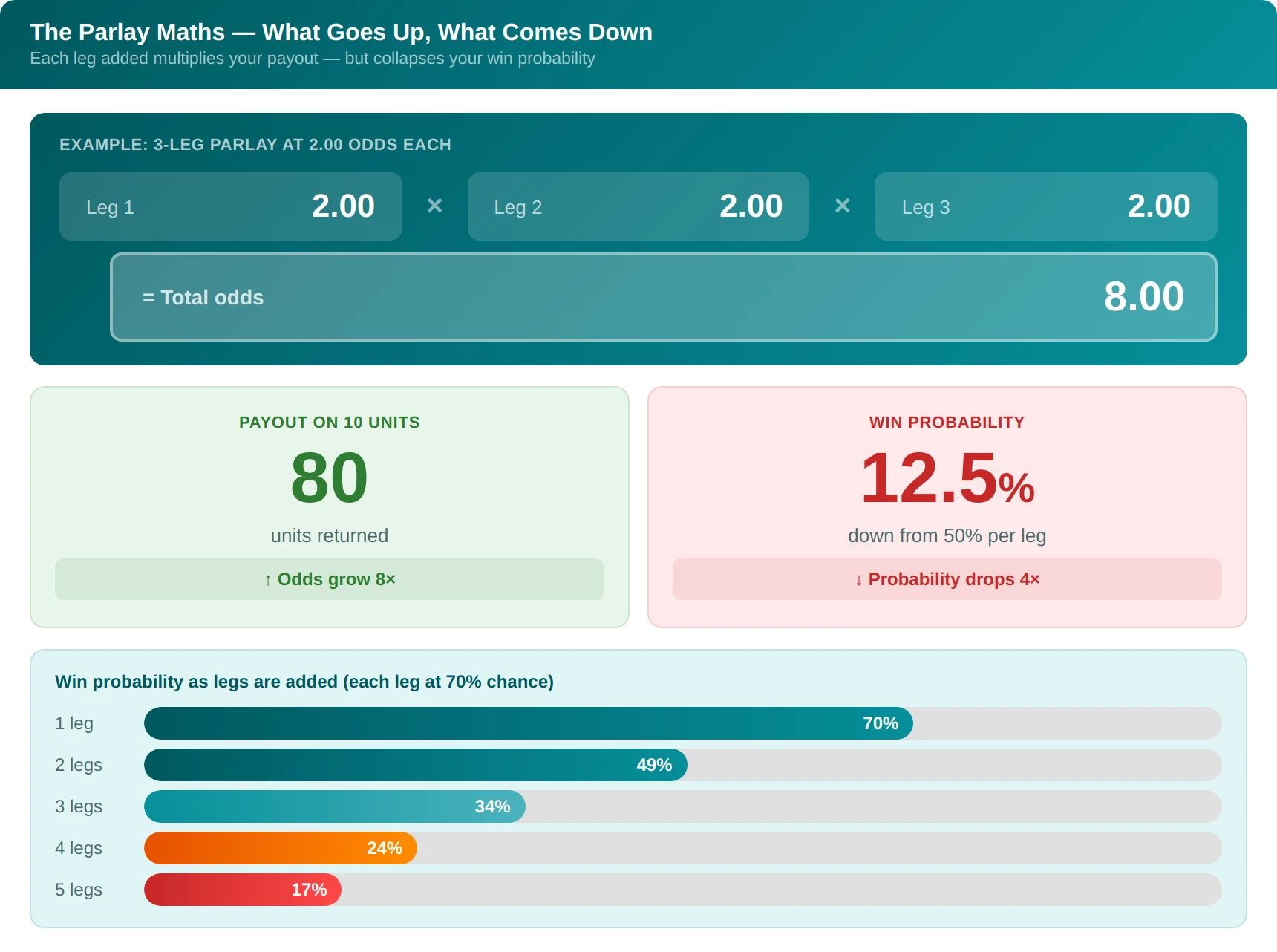
While payouts scale exponentially, your actual probability of winning drops sharply with each added event. Individual odds of 2.00 imply a 50% chance of winning. A three-leg parlay of 2.00 odds (2.00 × 2.00 × 2.00 = 8.00) drops your true implied win chance to 12.5%.
If a bookmaker takes a 5% margin on every single bet, that margin compounds across a 3-leg accumulator, giving the house a mathematical advantage of roughly 14.2%.
All-Legs-Must-Win Rule Explained
The all-legs-must-win rule creates a steep probability curve. Every added selection increases variance and volatility, meaning your chances of a total loss grow much faster than the odds increase.
A parlay operates with only two final results: a total loss or a complete win. There are no partial payouts for getting 4 out of 5 legs correct unless specific insurance promotions apply.
As legs are added, the overall probability of winning decreases. For example, combining four independent events, each with a 70% chance of winning, results in a total win probability of just 24% (0.70 × 0.70 × 0.70 × 0.70).
Sportsbook variance means long stretches of consecutive losses punctuated by infrequent, large wins. This requires strict capital discipline to avoid premature bankroll depletion.
How Payouts Are Calculated in Parlays
To calculate a cross-sport parlay payout, you must convert all selections into decimal odds. Multiply these decimals together, then multiply that product by your stake. For instance, a favourite vs underdog combination balances risk and reward. The payout structure reflects probability, covariance, and the bettor’s exposure.
A stake of 10 units on combined odds of 5.67 returns 56.70 units.
To calculate, simply multiply your stake by the total combined odds: Gross Return = Stake × Total Odds So, 10 × 5.67 = 56.70. This shows how exponential growth in odds translates into actual payout figures, reinforcing why careful leg selection is critical in cross-sport accumulator tips.
Common Sports Combined in Cross-Sport Parlays
Football and Basketball Combinations
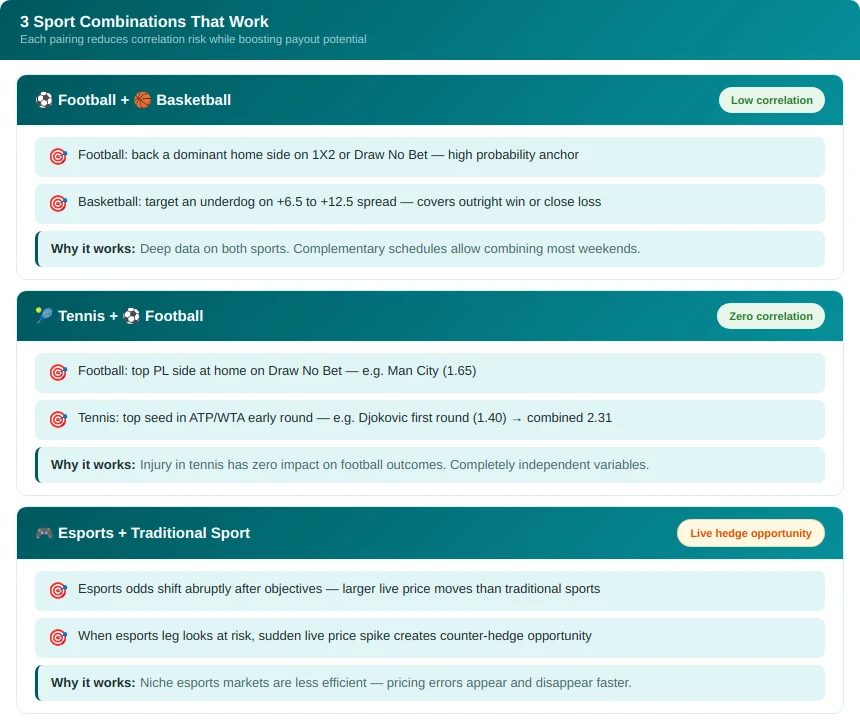
Combining football and basketball is a core strategy in cross-sport betting because of their high market liquidity, deep historical data, and complementary schedules.
Football and basketball are the best sports to combine for betting parlays. This is because both have predictable markets and strong statistical analytics. Bettors often hedge by mixing favourites in football with underdogs in basketball.
For example, select a dominant football club with a high win probability (e.g., Real Madrid or Manchester City playing at home). Focus on the Moneyline (1X2) or Draw No Bet (DNB) markets to keep risk low.
Target a basketball underdog with a large point spread (+6.5 to +12.5). Look for situational edges like team rest cycles, travel schedules, or an opponent looking ahead to a major rivalry game. The football leg provides high-probability security, while the basketball point spread covers multiple outcomes (an outright underdog win or a close loss), boosting the total 22bet parlay betting payout.
Tennis and Football Mixed Bets
Questions like “Can I combine football and tennis in one bet?” are common. The answer is yes - sportsbooks allow these combinations, but bettors must consider correlation risk and scenario analysis to ensure independence between outcomes. A practical strategy is to anchor your ticket with a high-probability football selection, such as a top Premier League side playing at home in a Draw No Bet (DNB) market.
Pair this with a tennis leg focused on a strong favourite in early-round matches at ATP or WTA tournaments, where historical win rates are high. For example, backing Manchester City to win at home (odds 1.65) alongside Novak Djokovic to win a first-round match (odds 1.40) produces combined parlay odds of 2.31.
This combination works because football and tennis operate under entirely different performance metrics and scheduling variables. A sudden injury in tennis has no bearing on football outcomes, reducing hidden covariance. By mixing a football favourite with a tennis anchor, bettors achieve diversification while targeting a respectable payout.
Esports and Traditional Sports Pairings
Modern punters increasingly combine esports betting odds with traditional sports. Because esports pricing changes in large, abrupt blocks after objectives are secured, it provides a distinct landscape for live-hedging a cross-sport parlay ticket.
When your backed esports team drops an early round or economic objective, the live odds will spike abruptly against them. Capitalise on this sudden, un-smoothed price shift by placing a calculated live counter-wager to lock in profit margin across both tickets.
Key Strategies for Multi-Sport Parlays
Mixing Favourites and Underdogs for Balance
Experienced punters often look for cross-sport accumulator tips that balance favourites and underdogs while reducing correlation risk across unrelated sports.
Mixing underdog vs favourite across different sports prevents a parlay from relying on a single market condition. It balances high-probability anchors with high-yield value accelerators. This is a classic hedging technique.
Using Different Sports to Reduce Correlation Risk
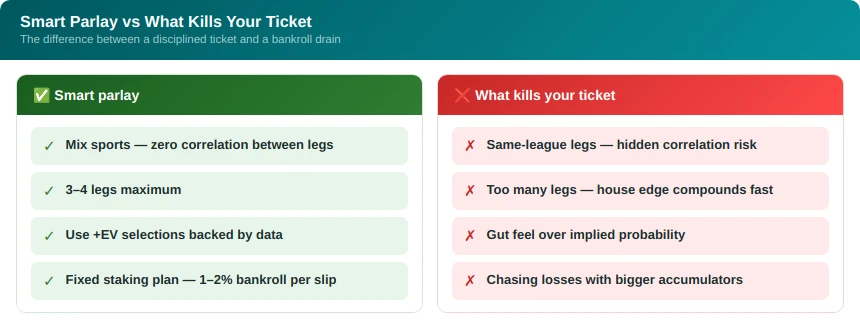
Betting on multiple matches within a single league introduces hidden correlation risk. For instance, pairing two English Premier League (EPL) matches exposes your bet slip to league-wide systemic variables, like bad winter weather, sudden refereeing trends, or a compressed holiday schedule.
Cross-sport diversification drops your mathematical covariance to zero. When you pair an indoor tennis match in London with a basketball game in New York, the variables governing each leg are completely independent. A sudden player injury, coaching change, or tactical shift in one sport has a 0% chance of impacting the other.
Pairing tennis and basketball is highly efficient for risk diversification because they incorporate completely different performance metrics, scoring systems, and physical demands.
Selecting High-Probability Selections per Leg
Selecting high-probability legs requires moving past gut feel and using strict statistical benchmarks. A true high-probability selection must match a high historical win rate with an implied probability that undervalues the actual outcome.
Top bettors use algorithmic optimiser tools, odds comparison platforms, and expected value tools to scan cross-sport markets for pricing discrepancies. These platforms use real-time data feeds to identify pricing discrepancies across bookmakers, helping bettors find positive expected value (+EV) before lines adjust.
Managing Number of Legs to Control Risk
Limiting the number of legs on a multi-sport bet slip is your most effective tool for managing risk. Every selection you add multiplies the house edge (vigorish) and increases your probability of a total loss. A disciplined staking plan ensures controlled leverage and sustainable bankroll management.
Advantages of Cross-Sport Betting
Higher Potential Payouts vs Single Bets
Cross-sport parlays offer a massive structural advantage over single bets: they generate exponential payout growth from a fixed, minimal capital outlay. Single bets scale linearly, meaning a wager of 100 units on three separate events requires a total outlay of 300 units to return incremental, independent profits.
If you select three high-probability outcomes across football, basketball, and tennis at odds of 1.70 each, betting them individually yields modest returns. Combining them into a single cross-sport ticket multiplies the odds to 4.91 (1.70 × 1.70 × 1.70). This lets you target benchmark-beating returns without increasing your initial stake.
Increased Entertainment Value Across Sports
Cross-sport parlays enhance engagement, allowing bettors to follow multiple sports simultaneously. This creates a catalyst for broader fan interest. They change how fans watch sports by linking independent games into a single narrative.
A single bet ticket connects different leagues, turning ordinary regular-season games into high-stakes events.
To get the most entertainment and tactical value out of your bets, map your ticket around peak live-broadcast windows.
Opportunities in Niche or Less-Efficient Markets
Less-efficient markets, such as niche betting markets in esports or minor leagues, offer opportunities for value betting and scenario-based forecasting.
Major betting markets like the English Premier League or the NBA are highly efficient because sportsbooks use massive data feeds and heavy trading volumes to refine their lines. In contrast, niche markets, like lower-tier esports, regional table tennis, or minor football leagues, receive far less bookmaker attention, leading to frequent pricing errors.
Risks and Common Mistakes in Parlays
Overloading Too Many Selections
Every leg added to a cross-sport ticket acts as a point of failure. The relationship between your total payout and your actual win probability is completely lopsided. While your potential returns grow exponentially on paper, your true probability of cashing the ticket decays at an accelerating rate.
Ignoring Implied Probability and True Value
Failing to calculate probability correctly leads to poor exposure and unsustainable portfolio outcomes. Inability to convert sportsbook odds into their implied probability causes punters to consistently back overpriced markets. This creates an unbalanced portfolio where selections carry excessive liability without sufficient long-term value.
Relying on Luck Instead of Strategy
Relying on luck or "gut feel" turns sports betting into a high-risk lottery with a guaranteed negative return over time. Professional cross-sport punters view sportsbooks as financial markets with pricing errors. They protect their capital using data analytics, predictive regression models, and strict bankroll discipline.
Cross-Sport Betting vs Single Bets
Risk and Variance Differences
The difference between single bets and cross-sport parlays is defined by how risk and variance compound. Single bets carry linear variance, while accumulators feature exponential variance that drastically alters your risk profile.
Long-Term Profitability Considerations
Is cross-sport betting profitable long-term? Only with disciplined bankroll management, hedging, and forecast modelling. It’s only profitable in the long run if your data models consistently find and back Positive Expected Value (+EV) across different sports.
If a punter only relies on luck or gut feel, the exponential compounding of the house margin (vigorish) will quickly drain their bankroll.
To build a sustainable, profitable strategy, you must combine three separate professional disciplines: advanced mathematical forecasting, strict capital management, and strategic live hedging.
When Parlays Make More Sense Than Singles
Major sportsbooks frequently enforce strict maximum stake limits on lower-tier, niche sports leagues (such as regional table tennis, Tier-2 esports, or minor football divisions) to insulate themselves from information asymmetry. If a quantitative model flags a severe mispricing in a niche market, a bettor may be blocked from placing a large enough single wager to fully exploit the edge.
Advanced Concepts in Cross-Sport Betting
Correlation and Independence Between Events
In multi-sport accumulators, the biggest hidden danger is correlation risk. That’s when two selections are influenced by the same external factor, like weather, refereeing trends, or league scheduling. If outcomes are correlated, your ticket loses its diversification advantage and behaves more like a single bet.
To counter this, punters should deliberately seek independent events across different sports. Pairing an indoor tennis match with a basketball game in another country ensures that performance metrics, scoring systems, and external conditions remain unrelated.
By applying analytics, regression modelling, and disciplined forecasting, bettors can uncover hidden correlations and avoid them, building a portfolio of selections that truly spreads exposure and strengthens long-term profitability.
Kelly Criterion and Staking Approaches
In cross betting, the Kelly Criterion calculates the precise percentage of your bankroll to risk on a wager, to maximise long-term exponential capital growth. It perfectly balances your calculated mathematical edge against the structural odds offered by the bookmaker.
Arbitrage and Market Inefficiency Concepts
Cross-sport parlays allow bettors to identify value across liquidity gaps and market inefficiencies using analytical models. A bookmaker's football trading desk operates independently from its esports or tennis trading desk. This operational division creates structural data silos, which create cross-sport market inefficiencies that analytical models can identify and act on.
Quantitative models often exploit inefficiencies by comparing bookmaker lines against market consensus, identifying where odds diverge from collective expectations.