


In the world of football betting, few markets are as popular among cautious bettors as draw no bet (DNB). A draw no bet is simple yet powerful: it eliminates the risk of losing when a match ends in a draw. Instead of betting on three possible outcomes like in 1X2 betting, you only focus on whether your team wins or loses. If the game ends level, your stake is refunded. This makes DNB particularly appealing for those who want to balance risk and reward. If you’re exploring the meaning of home draw no bet, the away draw no bet market, or simply weighing DNB against double chance and Asian handicap, understanding the draw no bet can sharpen your betting strategy and protect your bankroll.
How Draw No Bet Bets Are Settled
What does draw no bet mean in practice? To use this market effectively, it helps to understand the core settlement rules. Understanding the rules in detail helps bettors use this market strategically:
- Team wins → bet wins: If the team you backed secures victory in regular time, your bet is settled as a win, and you collect your payout based on the odds.
- Match ends in a draw → stake refunded: Unlike 1X2 betting, where a draw could mean a loss, here your stake is returned. This refund makes the draw no bet in soccer appealing to cautious bettors.
- Team loses → bet loses: If your chosen team is defeated, your bet is settled as a loss, just like in traditional markets.
Here is a hypothetical example of Chelsea versus Arsenal. Suppose you place a home draw no bet wager on Chelsea against Arsenal:
- If Chelsea wins 2-1: Your bet wins.
- If the game ends 1-1: Your stake is refunded - no profit, but no loss either.
- If Arsenal wins 0-1: Your bet loses.
This explains the home no bet meaning. You’re essentially betting on the home team to win, with insurance against the draw. Here is an away draw no bet example - Imagine backing Arsenal in the same fixture under an away market:
- If Arsenal win: Your bet wins.
- If the game ends in a draw: Your stake is refunded.
- If Chelsea win: Your bet loses.
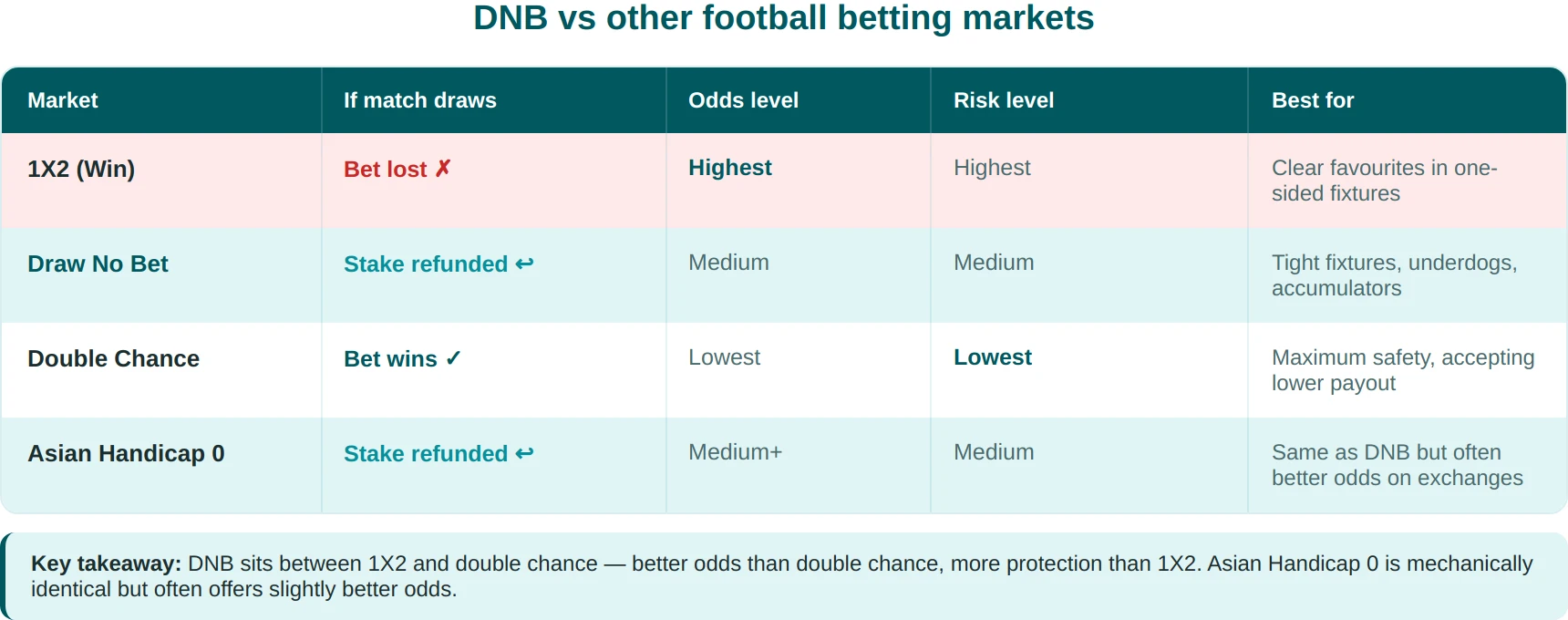
This shows the meaning of away draw no bet. It’s the same principle, but applied to the travelling team. The draw no bet strategy is particularly useful in matches where a draw is highly possible. For instance, in a tightly contested derby or a Champions League knockout tie, bettors often use DNB to protect themselves from losing money if the game ends level. By removing the draw outcome, the market simplifies betting decisions and reduces risk. That’s why many bettors consider DNB a middle ground between 1X2 betting and double chance.
Draw No Bet vs 1X2 Betting
In traditional 1X2 betting, you have three possible outcomes to choose from: home win (1), draw (X), or away win (2). This format is the most common in football betting and offers higher odds because you’re taking on more risk. If you back the home team and the match ends in a draw, you lose your stake. By contrast, the draw no bet means that the draw outcome is removed entirely. You’re left with only two possibilities: your team win (and so does your bet), or your team lose (and so does your bet). If the match ends in a draw, your stake is refunded. This reduction in risk makes DNB attractive to bettors who want a safety net. Because the draw option is eliminated, the odds in draw no bet markets are lower than in 1X2 betting. For example, Chelsea to win in 1X2 betting might be priced at 2.50. The Blues in a home DNB market could be priced at 1.80. The trade-off is that you sacrifice higher odds for the safety of a refund if the game ends level. Two core aspects to consider include:
- Home Draw No Bet: If you back the home team in a home DNB market, you win if they win. You get your stake refunded if the match ends in a draw, or you lose only if the away side win. This is the meaning of home no bet; essentially, betting on the home side with insurance against the draw.
- Away Draw No Bet: If you back the travelling team in an away DNB market, you win if the away side win. You get your stake back if the match ends in a draw, or you lose only if the home team win. The away draw no bet works the same way, but is applied to the visiting side.
A hypothetical example of a Premier League fixture is Liverpool vs Manchester City. In 1X2 betting, backing Liverpool means you lose if the game ends 1-1. In draw no bet, backing them means you win if they win, get your stake back if it’s a draw, and lose only if Manchester City win. This shows why many bettors prefer the draw no bet strategy in matches where a draw is highly possible. It reduces risk without completely sacrificing profit potential.
Draw No Bet vs Double Chance
Both DNB and double chance are designed to reduce risk compared to traditional 1X2 betting, but they work in slightly different ways.
- Double chance: Covers two outcomes - your team wins, or the match ends in a draw. This means you only lose if your team are defeated.
- Draw no bet: Refunds your stake if the game ends level, but only pays out if your team win. If your team lose, your bet loses.
When considering risk and reward balance, double chance is the safer option because it guarantees a positive outcome in two scenarios (win or draw). Draw no bet is riskier since you only profit if your team win, but it offers better odds than double chance. This trade-off is important: bettors who prioritise safety often lean toward double chance, while those who want a balance of protection and profitability prefer DNB. A practical example is a hypothetical matchup between Manchester United and Liverpool. Consider:
- Double chance: Backing United with a double chance means you win if United win or if the match ends in a draw. You only lose if Liverpool win.
- Draw no bet: Backing United with DNB means you win if United win, get your stake refunded if the match ends in a draw, and lose if Liverpool win.
This shows the difference: double chance covers more outcomes but at lower odds, while DNB offers higher odds but less coverage. If you compare the odds, Manchester United to win with double chance might be priced at 1.40. On the other hand, Manchester United, with a draw no bet, could be priced at 1.80. The definition of these markets highlights the trade-off. Double chance is safer but less profitable, while DNB is riskier but potentially more rewarding.
Draw No Bet vs Asian Handicap
The DNB meaning is closely tied to the Asian handicap market, particularly the level handicap (0). Many bettors consider them almost identical because the settlement rules are the same. If your team win, your bet wins; If the match ends in a draw, your stake is refunded, or if your team lose, your bet loses. Draw no bet and Asian handicap (0) eliminate the draw as a losing outcome. The two markets provide insurance against a draw, making them safer than 1X2 betting. Both are widely used in soccer predictions and betting strategy guides. While the mechanics are the same, there are subtle differences:
Odds and availability: Asian handicap markets often provide better value odds, especially in betting exchanges, because they are designed to balance the market mathematically.
Flexibility: Asian handicap offers more variations beyond the level handicap (e.g., -0.25, +0.5, -1.0), which can fine-tune your risk and reward. DNB is simpler and limited to the basic refund-on-draw structure.
Sports Coverage: While draw no bet meaning in soccer is most common, Asian handicap markets are widely used across multiple sports, including basketball, cricket, and hockey, making them more versatile.
An example could be a clash between Real Madrid and Bayern Munich. The prediction here is that backing Real Madrid with draw no bet means you win if they win, get your stake back if it’s a draw, and lose if Bayern win. Backing Real Madrid with an Asian handicap (0) works the same. However, if you choose Asian handicap -0.25, half your stake is placed on Real Madrid (0) and half on Real Madrid (-0.5). If the game ends in a draw, you get half your stake refunded and lose the other half. This flexibility doesn’t exist in DNB.
When to Use Draw No Bet
The draw no bet meaning becomes most valuable in specific betting scenarios where risk management is crucial. Knowing when to apply this market can make the difference between a profitable strategy and unnecessary losses.
In Tight Fixtures
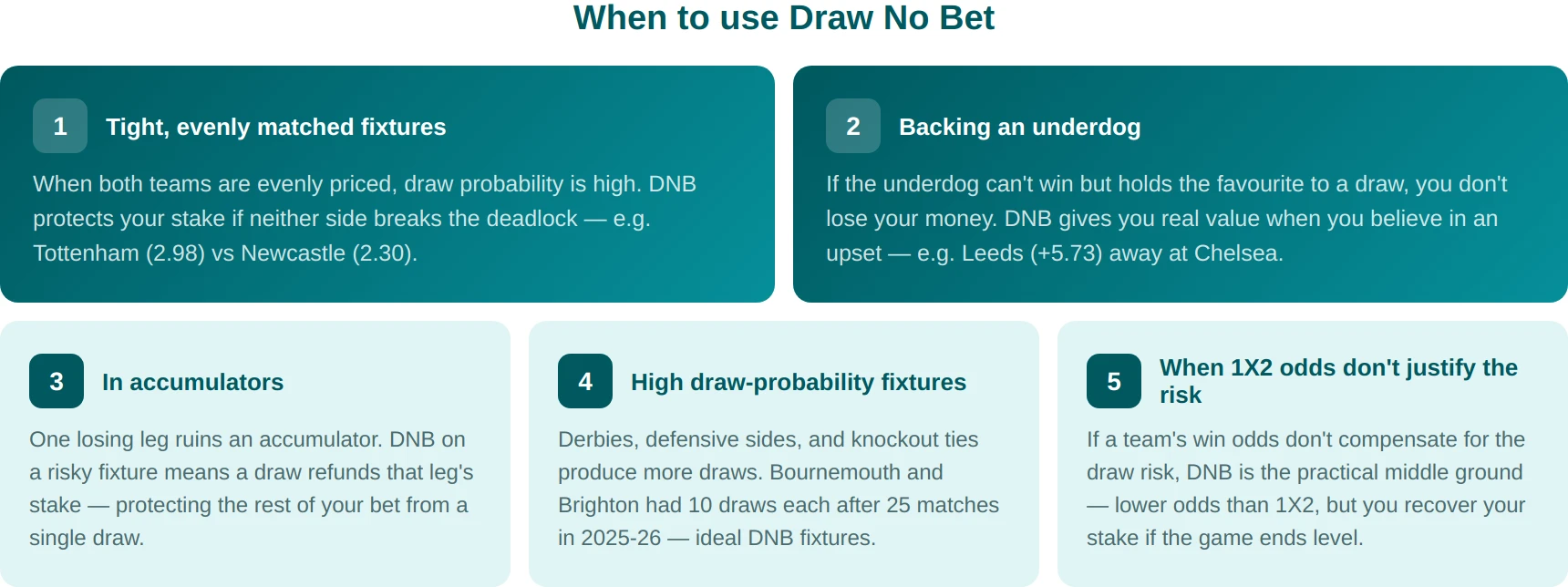
When two teams are evenly matched, the likelihood of a draw is higher. In these cases, backing either side with draw no bet allows you to profit if your team win while protecting your stake if the game ends level. In tight fixtures, a DNB dynamic is significant for a bettor’s choices. An example of this draw not bet meaning is highlighted in the pre-match odds of the match between Tottenham (2.98) and Newcastle (2.30), with a draw available at 3.54. This match was scheduled for 10 February 2026; the odds were finely balanced. A home draw no bet on Tottenham ensures you do not lose if Newcastle manage to hold them to a draw.
Backing an Underdog
If you believe an underdog has a realistic chance of upsetting a favourite, DNB provides insurance. Even if the underdog does not win but manages a draw, you do not lose your money. For example, according to Oddsportal, in the odds for the clash between Chelsea (1.56) and Leeds (5.73), with a draw at 4.31, Leeds are the underdogs against Chelsea in the Premier League. If Leeds win, you profit; if they draw, your stake is refunded. If Chelsea score and win, you lose. This is the meaning of ‘away draw no bet' when applied to the visiting side.
In Accumulators
Accumulators (multi-leg bets) are popular for chasing bigger returns, but one losing leg can ruin the entire bet. Using draw no bet in one or two risky fixtures reduces the chance of a complete loss. For example, in the Premier League, you might include Everton with DNB against Bournemouth. If Everton win, your accumulator continues. If they draw, your stake for that leg is refunded, protecting your overall bet.
Matches with High Draw Probability
Certain fixtures, such as local derbies or defensive-minded teams, often end in draws. Applying a draw no bet strategy here ensures you don’t lose money if the game finishes level. For example, Bournemouth and Brighton have the highest number of draws in the 2025/26 season after 25 matches, with 10 each. Therefore, in a matchup between these two sides, a home no bet or away no bet selection can safeguard your wager.
When Odds are Balanced
Sometimes, the odds in 1X2 betting do not justify the risk. Choosing a draw no bet is the best middle ground. Although a DNB is available at lower odds than outright win markets, it has the advantage of a refund if the game ends in a draw, thus underscoring its value to the bettor.
Advantages and Disadvantages of Draw No Bet
| Advantages | Disadvantages |
|---|---|
| Safer than 1X2 betting | Lower odds compared to 1X2 |
| Refund if the match ends in a draw | Less profitable if your team wins |
| Useful in accumulators | Not as safe as double chance |
| Clear and simple rules | Less flexible than Asian handicap |