



Accumulator bets, also called an ACCA bet or parlay, are one of the most exciting formats in sports wagering. The appeal lies in the potential to turn a small stake into a massive profit by combining multiple fixtures into one bet. But with high odds comes high risk. Building a successful 5+ match ACCA requires discipline, data, and strategy. 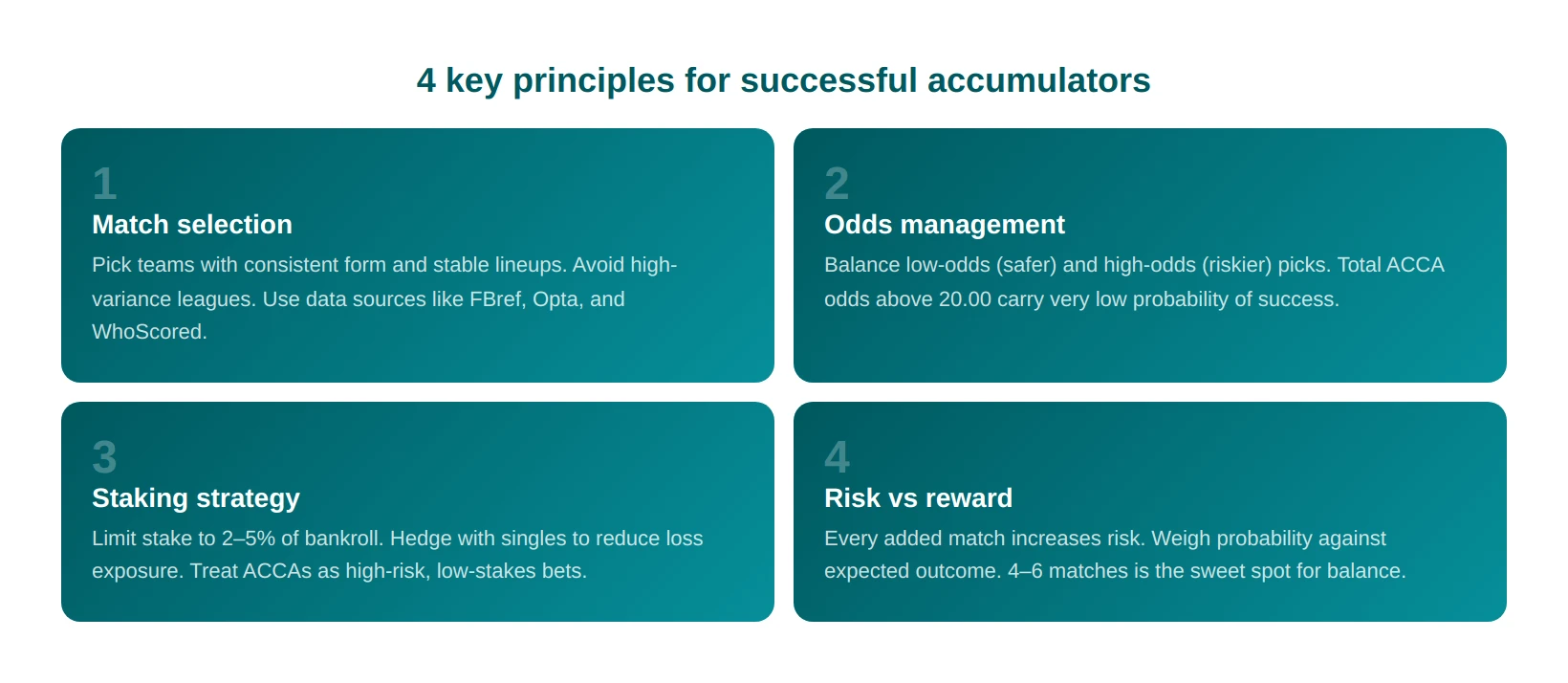
How Accumulators Work
Understanding how accumulators work begins with one rule: combine multiple selections into one wager, and every result must be correct. The odds multiply across each leg, creating huge potential reward, but also each added match makes it harder to win, because all selections must land.
Why 5+ Match Accumulators Are Challenging
The more matches you add, the greater the bookmaker’s margin and the lower your chance of success. For example, a 10-leg ACCA at 1.50 per leg gives 57.67 total odds, which are great for the bettor. However, you have to hit all 10 consecutive correct results, which makes it challenging to get right.
Key Principles for Successful Accumulator Betting
The decision-making process in using purchased or free accumulator tips requires a consideration of different aspects, including the criteria to select matches, odds management, staking strategy, and risk vs. reward dynamic for long parlays.
Match Selection Criteria
Prioritise teams with consistent form and stable lineups. For instance, the EPL’s form table, as of 27 March 2026, shows Arsenal, Manchester City, Brighton & Hove Albion, Manchester United, and Liverpool at the top of the form table in the previous six matches. These sides are the better candidates for an ACCA compared to the sides at the bottom of the form table, like Tottenham Hotspur, Leeds United, Burnley, and Chelsea, over the same period. Avoid leagues with high variance. Variance (measured by standard deviation by league) represents the extent to which a league is competitive. In this regard, La Liga is regarded as the most predictable (3.96), followed by the Premier League (4.54), Serie A (6.07), Bundesliga (6.45), and Ligue 1 (7.21). Take advantage of analytics and prediction models to guide your selection when building a long parlay. Use data sources in the football analytics field, such as FBref, Opta, and WhoScored, to access player profiles and transfer news, delivering detailed team profiles and transfer context to help inform your selection. Integrating analytics into betting strategies, like using aggregated advice such as football accumulator tips, combined with data analysis and practical betting advice, helps identify value bets and test different accumulator configurations.
Importance of Odds Management
Optimising value is the point of using smart ACCA tips. Balance between low odds accumulator tips (safer, smaller returns) and high odds accumulator tips (riskier and bigger payouts). The value of ACCAs is limited by probability. For example, total accumulator odds above 20.00 carry a very low probability of success. Let this guide your choices when building a long accumulator.
Staking Strategy for Accumulators
Responsible gambling comes into play when devising a staking strategy. Use proportional bankroll management. Limit stake size to between two and five per cent of your bankroll. Hedge with singles to reduce loss exposure. For instance, on a £100 bankroll, a £3 stake on a five‑match ACCA limits exposure while keeping the potential payout meaningful, while a small single bet on one of the matches cushions against a total loss.
Risk vs Reward in Long Accumulators
As you build your accumulator, keep the risk-reward balance in mind. Think of a hypothetical 5-match ACCA, where each match has odds of 1.40, the total accumulator odds will be 5.38. If you stake $10, the potential payout is $53.80. If, hypothetically, each match has a 70% chance, the probability will be 0.7 × 5 = 0.168. The expected value of this ACCA will be: EV = (0.168⋅53.80)−(0.832⋅10) = 9.04−8.32 = +0.72 This is a slightly positive EV, meaning the risk is mathematically justified, but only if your probability estimates are accurate. Remember that every added match increases risk. Smart bettors weigh probability against the expected outcome before committing.
Choosing Matches That Fit Together
Statistical Correlation Between Matches
Avoid correlated patterns, like betting on different aspects dealing with the same team in a match. In a hypothetical game between Manchester City and Arsenal, betting “Manchester City to win” and “Manchester City to score over 1.5 goals" comprises a correlated pattern. Statistically, if Manchester City score two or more goals (Bet B), the mathematical probability of them winning (Bet A) increases. Because the two events are not independent, bookmakers will either block the accumulator or price it through a bet builder.
Avoid Overlapping Risks
In the 2025/26 season, when Arsenal, Manchester City, Chelsea, Newcastle, or Tottenham play at the weekend after a midweek match in the Champions League, they face similar gruelling schedules. Such midweek exertions affect their respective team selections, fitness levels, and performance levels. Overlapping risks occur when you stack bets on multiple teams that are facing the same external disadvantage, such as fixture congestion, midweek Champions League outings, or relegation fights. So, avoid overlapping risk when building on ACCA bet tips involving sides playing on Sunday after they participated in the UEFA Europa League or Conference League on the preceding Thursday. Diversify strategy by excluding teams facing congestion with teams on a standard “Saturday-to-Saturday” schedule.
Using Form and Head-to-Head Data
Trend analysis and historical results provide a window into how teams perform in specific matches. For instance, in the EPL, combining recent form (momentum) with head-to-head (H2H) data (historical matchups) helps you identify “bogey teams” or psychological edges that raw league standings might hide. Liverpool have been Arsenal’s bogey team, especially in recent seasons. In their last seven meetings in the EPL, Arsenal have won once, Liverpool have two wins, and the remaining four matches have ended in draws. In their meeting on 6 January 2026, at the Emirates, Arsenal were held to a 0-0 stalemate despite being in better form.
Avoiding Fixture Congestion Traps
In Ligue 1, one example is the match between the top two teams in France’s top division, PSG vs Lens. It was scheduled for 11 April 2026 but will now take place on 13 May 2026 to allow PSG to prepare for their quarter-final clash against Liverpool over two legs in the Champions League. Rescheduling enables Luis Enrique to plan better with the lineups and optimise his squad for the Champions League clash against Liverpool and Ligue 1. Check rescheduling patterns before building ACCAs. When fixtures are moved due to European competitions, anticipate that managers will rotate their lineups. This often affects tempo, possession, and overall formation stability. Also, watch out for fatigue; teams playing multiple competitions in quick succession are more prone to injury and fatigue, which can shift HT/FT outcomes. In congested periods, avoid assuming a dominant team will always secure a Home/Home halftime/full-time bet. Instead, consider Draw/Home or Draw/Away outcomes, since strong sides may conserve energy early.
Value vs Favourite Bias in Accumulators
Value betting involves placing wagers when the odds offered by a bookmaker are higher than the actual probability of the outcome. It involves identifying mispriced odds, giving the bettor a mathematical edge over the bookmaker. In ACCAs, value is crucial to the bettor, especially when compared side-by-side with the favourite bias. Smart accumulator betting tips focus on value betting, which involves finding the underestimated probability instead of blindly backing favourite teams. Consider a match between a mid-table La Liga side versus a top-four-chasing side in the league. A bookmaker offers odds of 2.22 for the mid-table side to win. By using the formula (1/odds) X 100, we see these odds imply a 45% probability of a home win. To find value, a bettor compares this to an objective data source, such as Forebet’s statistical probability output or a personal Poisson distribution model. If Forebet assigns the mid-table side a 55% win probability, a significant "value gap" exists: bookmaker implied probability (45%), statistical model probability (55%), and the value edge (+10%). By including this selection in an accumulator rather than a "heavy favourite" at odds of 1.20 (which the market tends to overprice), the bettor ensures that the compounded odds of the ACCA are mathematically working in their favour, rather than just stacking low-yield risks.
Using Prediction Tools and Data Services
Platforms like Forebet, PredictZ, and Windrawwin are free and can provide statistical analytics and prediction models:
| Predictive Platform/Data Service Provider | Utility and Features | Limitations |
|---|---|---|
| Forebet | Covers a wide range of leagues. Mathematical models generating win/draw/loss percentages and predicted scores. | Lacks real-time injury and lineup updates. |
| PredictZ | Easy to use. Relies heavily on historical results. Form-based previews with head-to-head data. | Weaker during managerial or squad changes. |
| Windrawwin | Useful for spotting patterns. Focus on head-to-head records and league trends. | Limited integration of live team news. |
When to Cash Out: Smart Exit Strategies
Monitoring the progression of an ACCA allows the bettor options, especially choosing when to cash out or limit their losses. Bookmakers offer cash-out options. Exiting early secures profit or minimises losses when later matches look risky. Imagine you have placed a $10 five-match accumulator with a potential return of $200. Three of your five legs have already landed successfully. You are now waiting on the fourth match (Illustrative Team A vs. Illustrative Team B), where you backed Team A to win. One hour before kickoff, a key injury is announced for Team A’s star striker. The bookmaker offers you a cash-out value of $65. Before deciding, you should assess the following:
Value assessment: Compare the offered cash‑out against the expected payout if the bet runs its course.
Residual probability: Re‑evaluate the likelihood of your remaining selections winning given new information.
Hedging vs cashing out: Decide whether to place a single bet on the opposite outcome to protect your stake, or accept the cash‑out to lock in a profit whichever way the match ends.
Mistakes to Avoid in 5+ Match Accumulators
Building an ACCA is not an exact science. There are several pitfalls bettors should look to avoid: 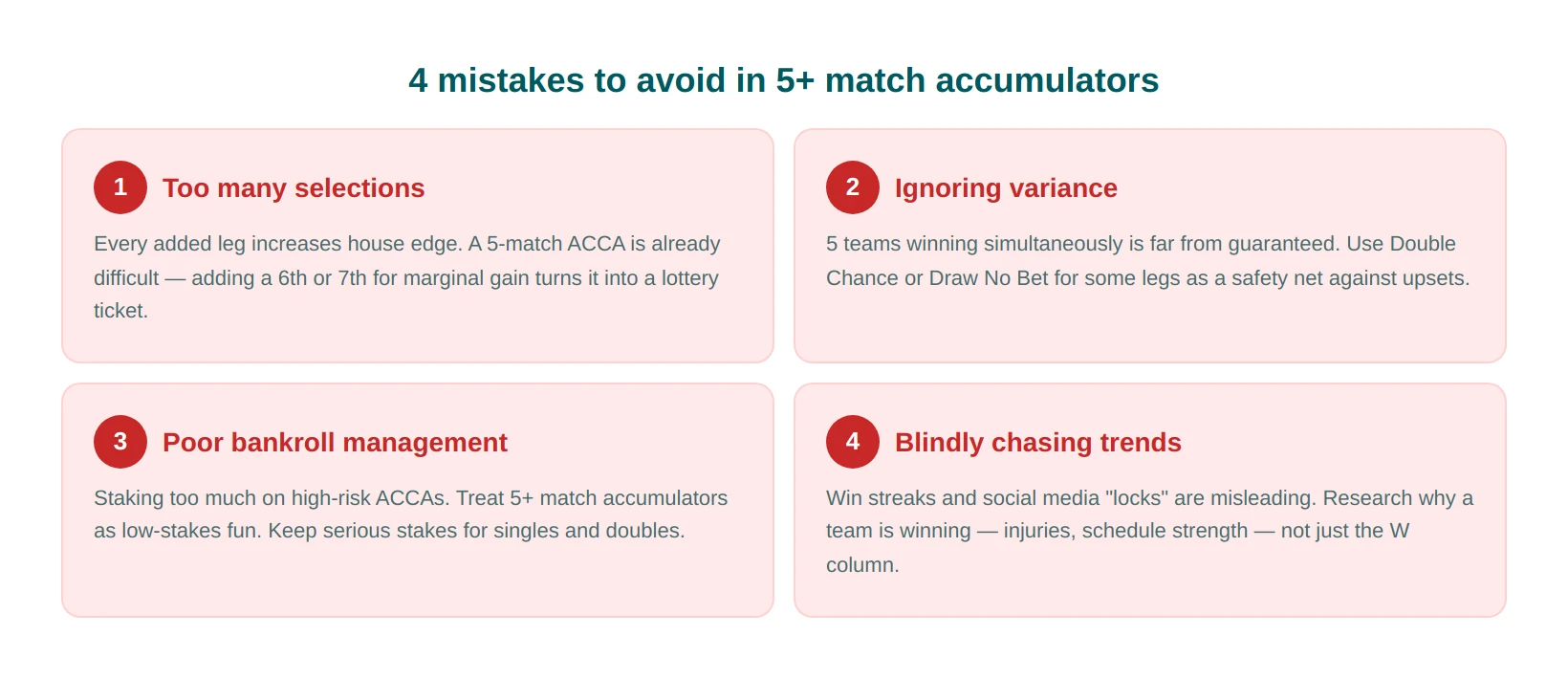
1. Adding Too Many Selections
Avoid too many selections because they compound the potential for losing the ACCA. Every added leg increases the house edge and the statistical probability of an upset. A five-match accumulator is already difficult to land, so adding a sixth or seventh leg for a marginal gain turns a calculated bet into a "lottery" ticket. Limit the number of legs and prioritise quality over quantity. If you lack confidence in a selection, remove it rather than forcing it for a higher payout.
2. Ignoring Variance
Five teams winning simultaneously in a single weekend is far from guaranteed, regardless of individual probability. Use tools like "Double Chance" or "Draw No Bet" for some legs to provide a safety net against unpredictable match events.
3. Poor Bankroll Management
Balancing the risk and reward is a driving force behind a good ACCA strategy. The mistake to avoid is staking too much of your total betting fund on high-risk accumulators. Treat 5+ match accumulators as high-risk, low-stakes fun. Keep your serious "investment" stakes for single or double bets where you have a higher probability of consistent returns.
4. Blindly Chasing Trends
Trends are misleading when picking teams for an ACCA. Betting on teams solely because they have a "win streak" or because "everyone on social media" says they are a lock is a pitfall that should be avoided. Conduct your own research into why a team is winning (e.g., injuries, strength of schedule) rather than just looking at their recent "W" column.
Managing Bankroll for Long Accumulators
When betting on long ACCAs, it is essential to allocate a fixed bankroll dedicated solely to these long accumulators, ensuring that your overall betting funds remain protected. A disciplined staking plan, whether using a flat stake or a percentage of your bankroll, helps maintain consistency and prevents reckless wagering. Treat each accumulator as one move in a longer strategy, not a standalone gamble.
Successful Accumulator Builds
There is no guarantee in ACCAs. They are high-risk bets, and this should be taken into account when building one’s strategy. However, some ways have improved chances of success. The two main approaches are low-odds picks for safer, consistent returns and high-odds picks that combine statistical underdogs for bigger payouts. To understand how an accumulator functions in practice, consider this illustrative five-match selection. This example demonstrates how individual odds multiply to create a higher potential payout from a single stake:
| Match (Illustrative) | Selection | Individual Odds |
|---|---|---|
| Team A vs Team B | Team A to Win | 1.50 |
| Team C vs Team D | Over 2.5 Goals | 1.70 |
| Team E vs Team F | Both Teams to Score | 1.80 |
| Team G vs Team H | Team G to Win | 1.40 |
| Team I vs Team J | Draw | 3.20 |
Total Combined Odds: 20.56 Hypothetical Stake: $10 Projected Return: $205.63 All five outcomes must be correct for the bet to win. If any single match result fails, the entire stake is lost, reflecting the high-risk and high-reward nature of this strategy.