


.jpg)
While FIFA tournaments and World Cup qualifiers have showcased the continent’s talent and prospects, questions remain about whether Africa’s footballing heritage and legacy receive the same prestige as those of their European or South American counterparts. From the Africa Cup of Nations (AFCON) to the rise of top African football players in elite leagues, the story of African football is one of resilience, development, and growing infrastructure. However, challenges in broadcasting, sponsorship, and international audiences continue to limit its visibility. So, does African football get enough global recognition? The short answer is no, not yet. African football punches above its weight on the pitch but remains undervalued commercially and in terms of media coverage.
The Rise of African Football
Grassroots academies, such as Right to Dream in Ghana, Génération Foot in Senegal, ASEC Mimosas in the Ivory Coast, have become pipelines for global talent, producing stars like Mohammed Kudus, Sadio Mané, and Yaya Touré. Scouts from European clubs now maintain a permanent presence at these academies, reflecting how central African development has become to the global game.
Nations like Senegal (quarter-finalists at the 2002 FIFA World Cup) and Morocco (semi-finalists at the 2022 World Cup in Qatar) have performed well in FIFA tournaments. The 2026 World Cup expansion, which grants Africa nine direct qualifying slots, up from five in previous tournaments, is a clear indicator of the continent's growing influence within FIFA.
Why African Football Often Feels Undervalued Internationally
AFCON has been held since 1957 — three years before the Euros — yet it is consistently treated as a secondary tournament by global broadcasters and sponsors. This gap in perception is largely commercial rather than competitive.
European media narratives and limited broadcasting rights have contributed to this undervaluation. Mohamed Salah's AFCON performances, for instance, receive significantly less attention than his Premier League displays, despite Egypt reaching the 2021 AFCON final. Similarly, Sadio Mané's winner's medal from the same tournament was largely overshadowed by Liverpool's Premier League title race. This disparity reflects how African competitions are weighted by global media, rather than the players' standing.
The Role of the Africa Cup of Nations in Global Visibility
Despite some post-tournament controversy surrounding the final between hosts Morocco and Senegal, the 2025 AFCON in Morocco was a major success operationally and commercially, marked by strong infrastructure and a 90% revenue surge.
In terms of audience reach, CAF AFCON Morocco 2025 saw a preliminary 61% growth across the European, Asian, and South American markets. In the UK alone, more than three million viewers tuned in to watch the final on Channel 4, highlighting the tournament’s expanding global footprint. These numbers underscore AFCON’s role as the flagship vehicle for African football’s global reach.
However, the tournament lags its European and South American counterparts, as well as the World Cup, and club-based tournaments like the EPL and Champions League. For global recognition, AFCON must be marketed as equal in importance to other continental tournaments, with improved contracts, sponsorships, and audiences.
African Players and Their Influence in Top European Leagues
African players in the Premier League and La Liga have reshaped European football. Stars like Didier Drogba, Samuel Eto’o, and Yaya Touré left a lasting heritage, while current icons such as Salah, Mané, and Victor Osimhen continue to dominate. Even South African soccer players in Europe have contributed to this influence.
Steven Pienaar holds the record for the most Premier League appearances by a South African (214) at Everton (189), Tottenham Hotspur (10), and Sunderland (15).
Their success highlights the continent’s prospects and the impact of migration and diaspora in football globalisation:
| Player | Leagues | Major Achievement(s) |
|---|---|---|
| Didier Drogba | Premier League | Key figure in Chelsea’s first league titles under Mourinho; four-time Premier League winner |
| Samuel Eto’o | La Liga, Serie A | Integral to Barcelona’s treble (2009); Champions League winner with Inter (2010) |
| Yaya Touré | Premier League | Central to Manchester City’s rise; three-time Premier League champion |
| Mohamed Salah | Premier League | Liverpool’s all-time top Premier League goalscorer; pivotal in the 2019 Champions League win |
| Sadio Mané | Premier League | Crucial in Liverpool’s 2019 Champions League and 2020 Premier League triumphs |
| Victor Osimhen | Serie A | Led Napoli to their first Serie A title in 33 years (2023) |
| Steven Pienaar | Premier League | Everton stalwart with 214 Premier League appearances, who shaped their midfield identity |
Media Coverage and Broadcasting Challenges for African Competitions
CAF's revenue model depends heavily on broadcasting rights because sponsorship and merchandising income still lag behind that of European federations.
African competitions attract lower international rights fees than the EPL or Champions League, which in turn limits budgets available for production quality, promotion, and global distribution. As a result, many international audiences engage with African football primarily through European club competitions rather than continental tournaments.
However, the 61% audience growth recorded at AFCON 2025 demonstrates that demand clearly exists, and the gap lies not in interest, but in distribution and investment.
The Economic and Commercial Growth of African Football
Estimates show that the Africa Cup of Nations in 2025 was projected to generate USD 192.6 million in revenue, with a net profit of USD 113.8 million. Anchored by a mix of global and regional sponsors spanning energy, finance, sportswear, consumer goods, technology, and logistics, AFCON 2025 serves as a clear example of the economic and commercial impact of African football. 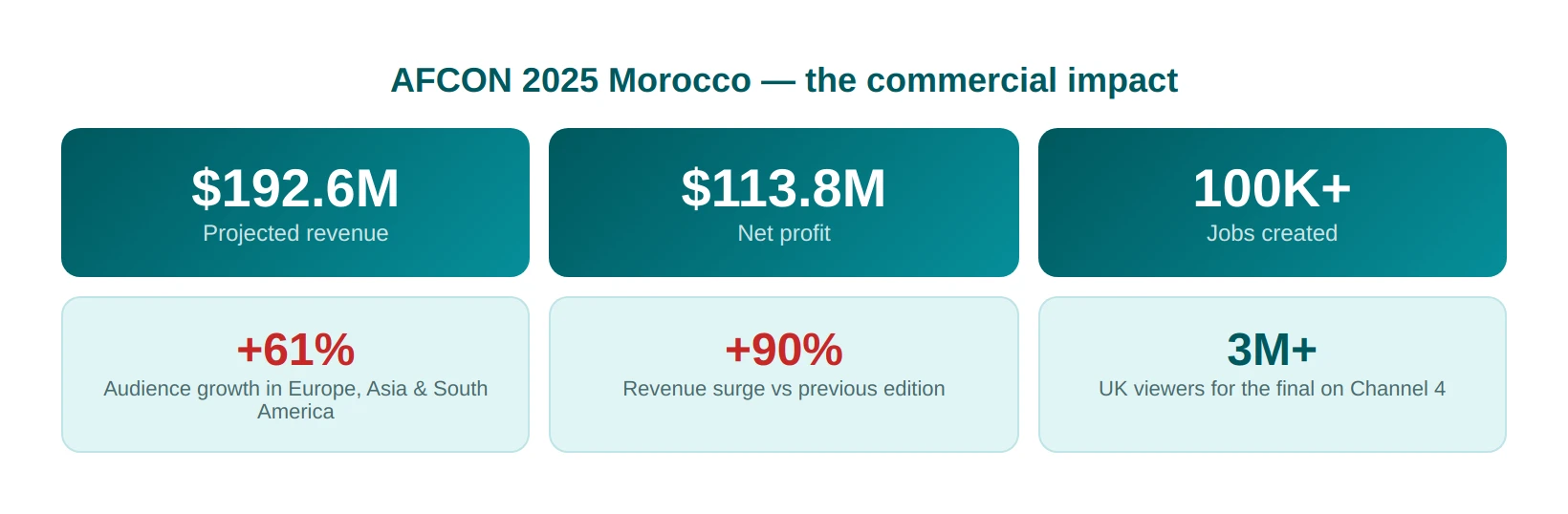 As the host, Morocco is also set to benefit from improved infrastructure and the creation of more than 100,000 jobs. The economic case for investing in African football is no longer speculative, as AFCON 2025 has demonstrated that the commercial infrastructure is in place.
Football as Soft Power for African Nations
Football gives African nations a global platform that diplomatic channels rarely match. Morocco's co-hosting of the 2030 World Cup alongside Spain and Portugal is a statement of regional ambition that strengthens trade ties, tourism, and international standing.
Hosting AFCON and the 2030 World Cup reinforces Africa's capacity to deliver major global events, translating directly into investment and reputation.
Key Moments That Boosted Africa’s Global Football Reputation
Several milestones have elevated Africa’s standing in the world of football. 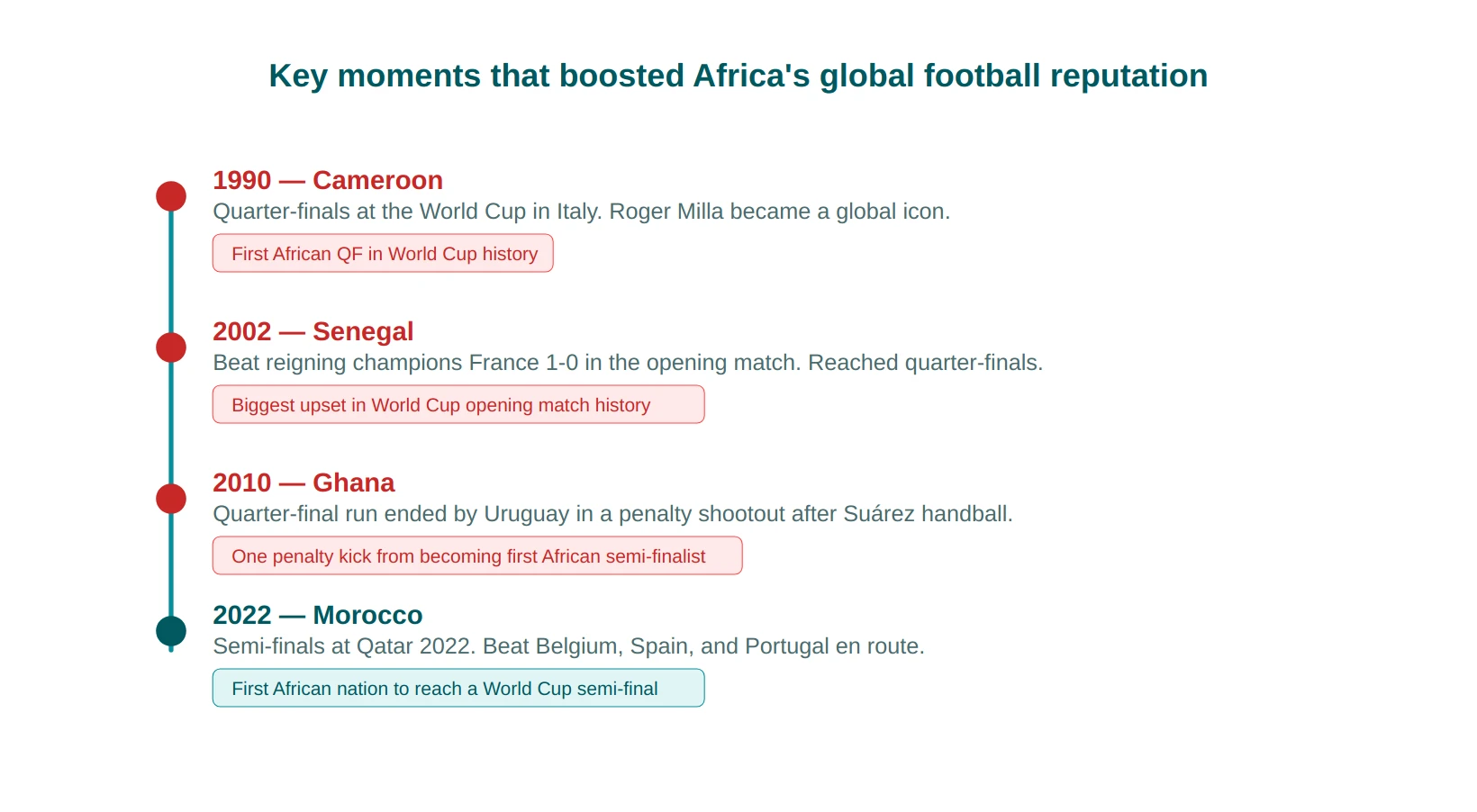
- Cameroon reaching the quarter-finals of the 1990 World Cup
- Senegal’s shock victory over France in the 2002 World Cup
- Ghana’s quarter-final run in the 2010 World Cup that ended in a penalty shootout loss to Uruguay
- Morocco’s historic semi-final in the 2022 World Cup
Each of these moments triggered a spike in European interest in African players and football. Transfers of African stars to the EPL, La Liga, Bundesliga, Serie A, and Ligue 1 accelerated after each tournament breakthrough, boosting both CAF's commercial value and AFCON's global profile.
What Still Limits the Global Recognition of African Football
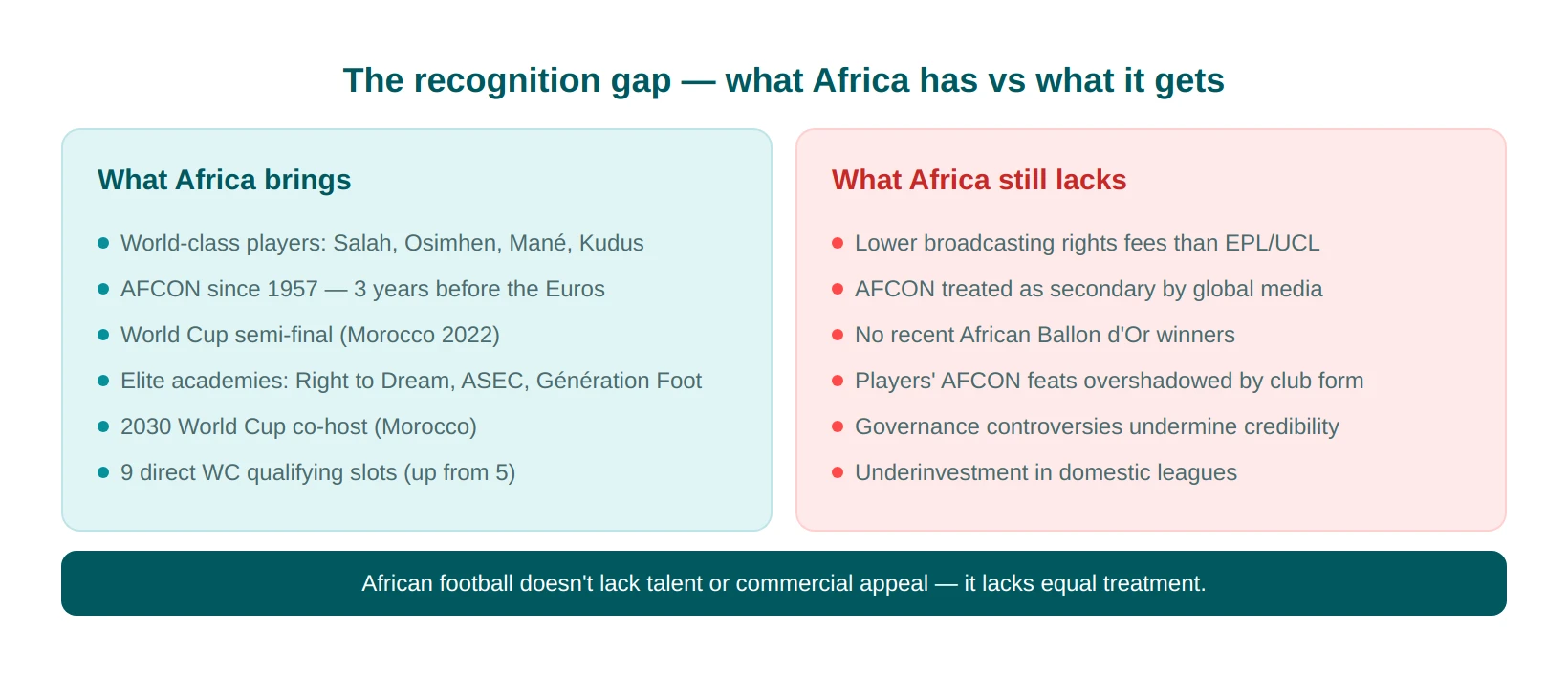 Leadership and governance within CAF present structural challenges to African football. For example, Morocco were officially crowned the 2025 AFCON champions after a contentious CAF ruling stripped Senegal of their title in March 2026. The decision overturned Senegal’s victory, citing alleged irregularities in player eligibility and officiating during the final. It sparked widespread debate, with critics arguing that it undermined the competition’s credibility. This controversy overshadowed what should have been a successful tournament and highlighted how governance issues continue to limit African football’s global recognition.
Limited broadcasting, undervalued contracts, weak infrastructure, and a lack of consistent investment also hinder African football. The absence of Africa Cup of Nations players as winners in major individual awards like the Ballon d’Or in recent years reinforces the perception gap. Until African achievements are celebrated equally, the continent’s football will continue to be undervalued in global rankings and prestige assessments.
The Future of African Football on the World Stage
With expanded World Cup qualifiers, football academies, and scouts identifying African talent, the continent is poised for greater influence. The 2030 co-hosting of the World Cup in Morocco will be a milestone that further increases the African football profile. Improved sponsorship, better broadcasting contracts, and investment in specific African football leagues, including the Kenyan Premier League, the Nigeria Premier Football League, and the South African Premiership, are the practical steps that will determine whether the continent's growing profile translates into lasting global recognition.
African football doesn’t lack talent, infrastructure potential, or commercial appeal. What it lacks is equal treatment — in broadcasting deals, in award recognition, and in how global media covers the continent's tournaments. Until that changes, the answer to the title question remains: not yet.