


.jpg)
Football is a game of constant evolution, and nowhere is that more evident than in the careers of the African players abroad who’ve reinvented themselves by changing position. From defenders turned strikers to wingers reshaped into wing-backs, these transformations have extended careers and created legends. 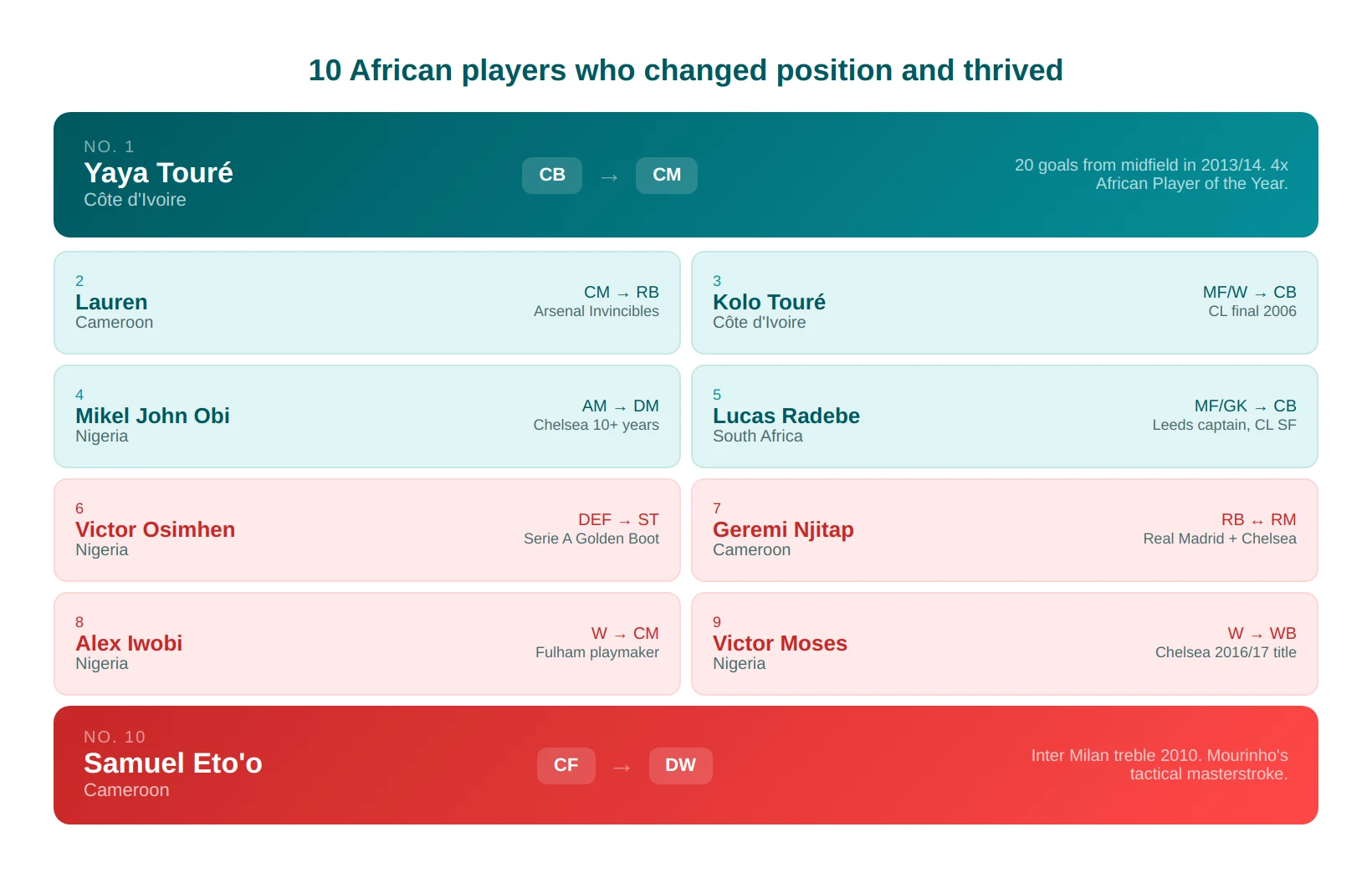
When Changing Position Transforms a Career
Football careers are rarely linear. Many African players have thrived after reinventing themselves in new tactical roles. A positional change unlocks hidden strengths, extends longevity, and even redefines a player’s legacy.
International football is filled with players who have changed positions to transform their careers. Gareth Bale shifted from left-back to winger and saw his career transform, earning him a move to Real Madrid. Cristiano Ronaldo is also an iconic change in position, moving from right winger to a forward in the middle, which changed his goalscoring numbers positively, especially at Real Madrid.
African players are not an exception when it comes to changing positions with positive career transformations.
Why Footballers Change Position
Managers’ styles, players’ abilities, team needs, and the culture of football intersect to create conditions necessitating, facilitating, and sustaining positional changes among players. 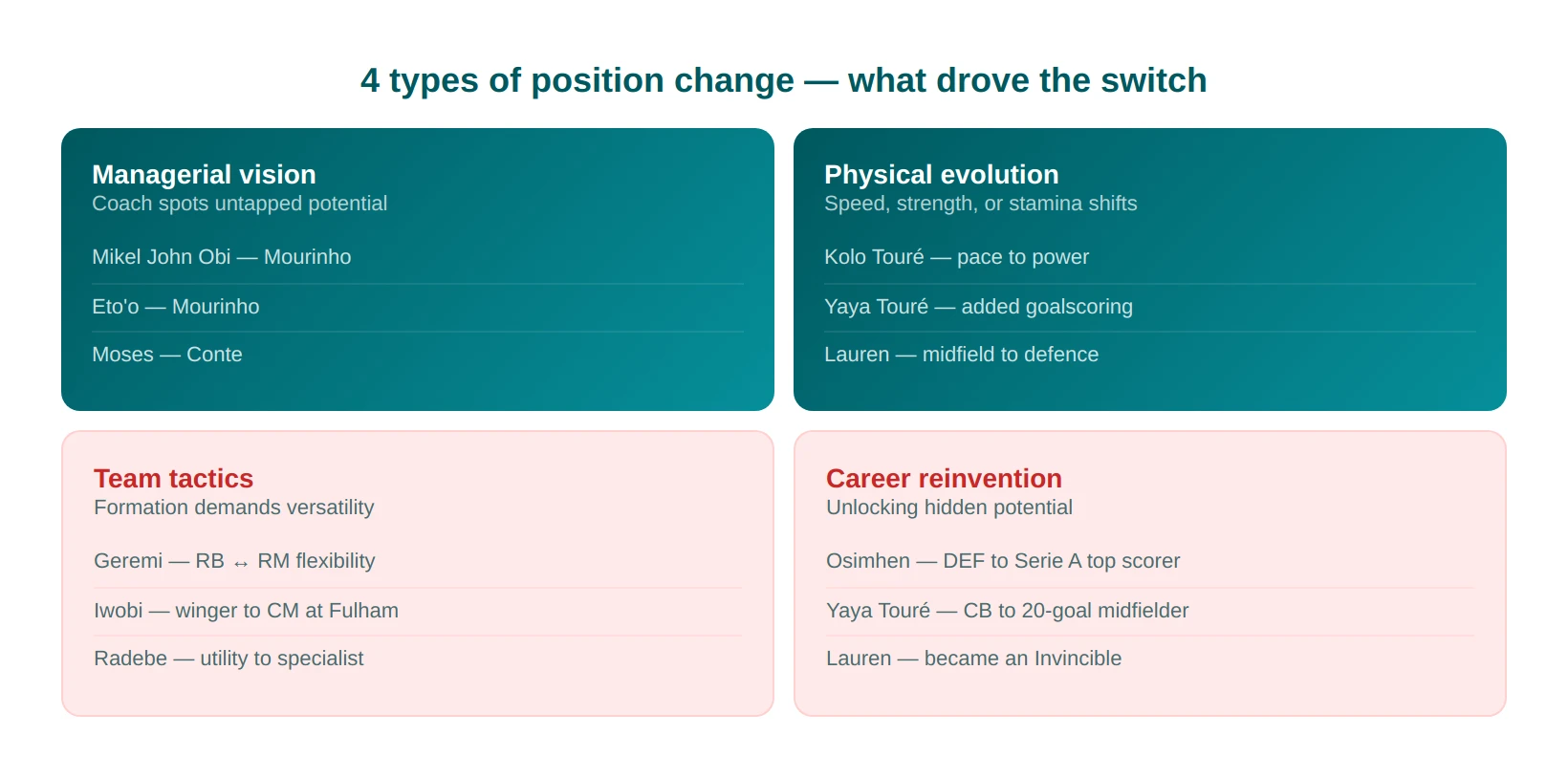 Jose Mourinho, a successful manager at Porto, Chelsea, Inter Milan, and Real Madrid, is known for changing several players’ positions successfully. For example, at the Blues, he shepherded the successful transition of John Obi Mikel from an attacking midfielder to one of the most reliable defending midfielders in Chelsea history. At Inter Milan, he oversaw the switch of Samuel Eto'o from centre-forward to a defensive winger to, winning the treble in 2010.
Yaya Touré played primarily as a defensive midfielder at Barcelona, occasionally filling in at centre-back, including in the 2009 Champions League final due to defensive injuries. His move to Manchester City saw him evolve into a marauding box-to-box midfielder and eventually a prolific goalscorer under Manuel Pellegrini. This change was driven by Toure’s abilities and suitability for the physical EPL style.
Geremi Njitap (right midfielder to right-back), and Alex Iwobi from winger (at Arsenal) to midfielder (at Everton and Fulham) show players' abilities and physical evolution can drive a change in position.
Therefore, players change positions due to:
Managerial Decisions: Coaches spot untapped potential in different areas of the pitch, like Jose Mourinho with Mikel John Obi and Samuel Eto’o.
Team Tactics: A squad’s formation may demand versatility, like Geremi Njitap at Real Madrid and Chelsea.
Physical Evolution: Speed, stamina, or strength changes over time, like Kolo Toure at Arsenal and Yaya Toure at Man City.
Career Longevity: Moving deeper or wider prolongs a player’s impact, like Lauren at Arsenal.
10 African Players Who Successfully Changed Position
Some of the great African names, like Yaya Toure, Mikel John Obi, and Victor Osimhen, are among the top 10 African football exports to Europe that did not always play in the positions they are known for, necessitating an exploration of their career trajectories.
1. Yaya Touré (Côte d'Ivoire): Center-Back to Midfield
The 2013/2014 season captured Yaya Toure's career high. The Manchester City player scored 20 goals from midfield to help his side reach the Premier League under Manuel Pellegrini.
Touré, however, famously played as a centre-back for Barcelona in the 2009 Champions League final, a 2-0 win against Manchester United. His transition to a marauding box-to-box midfielder saw him win four African Player of the Year awards.
2. Lauren (Cameroon): Midfielder to Right-Back
Originally a midfielder at Mallorca, Lauren was converted into a right-back by Arsène Wenger after joining Arsenal. He became a vital component of the "Invincibles" squad that went unbeaten during the 2003-04 season.
3. Kolo Touré (Côte d'Ivoire): Midfielder/Winger to Centre-Back
Legendary Arsenal defender, Kolo Touré, started his career with the Gunners as a utility winger and midfielder. This start was a far cry from the robust partnership he eventually built with Sol Campbell at the heart of Arsene Wenger’s defence.
The brother of Barcelona and Manchester City midfielder Yaya Touré, Kolo ended up becoming one of the few African players to reach the Champions League final in 2006, where he partnered Philippe Senderos for Arsenal after Sol Campbell had left the club earlier in 2006.
4. Mikel John Obi (Nigeria): Attacking Midfielder to Defensive Midfielder
In 2006, a young Nigerian was in the middle of a transfer fight involving English giants, Manchester United and Chelsea. The prospect was young Mikel John Obi. He had won the Silver Ball at the 2005 U-20 World Cup playing as a number 10 (attacking midfielder), losing the Golden Ball to one diminutive Argentinian, Lionel Messi.
After moving to Chelsea in 2006, José Mourinho famously converted him into a disciplined holding midfielder, a role he executed for over a decade while winning multiple major club trophies.
5. Lucas Radebe (South Africa): Midfielder/Goalkeeper to Centre-Back
Early in his career at Kaizer Chiefs, "The Chief" was an adaptable player who occasionally played as a goalkeeper, capturing versatility among South African Premiership players. After moving to Leeds United, he transitioned into a world-class centre-back, eventually captaining the club to a Champions League semi-final.
6. Victor Osimhen (Nigeria): Defender to Striker
Surprisingly, the 2023 CAF Player of the Year started his youth career as a defender. His switch to the striker role proved historic, as he led Napoli to their first Serie A title in 33 years and became the first African to win the Serie A Golden Boot. With 26 goals in a single season, he broke Samuel Eto'o's previous record of 21, and surpassed George Weah's career total to become the all-time highest-scoring African in Serie A history.
7. Geremi Njitap: Right-Back to Midfield for Real Madrid and Chelsea
Geremi’s versatility allowed him to switch between right-back and midfield for Real Madrid and Chelsea, showcasing tactical flexibility across elite squads. Transfermarkt has Geremi as a right midfielder, however, he was just as comfortable slotting in at right-back for Real Madrid and Chelsea. He went on to win the EPL title twice (2004/05 and 2005/06) and become one of the greatest African players in Chelsea history.
8. Alex Iwobi (Nigeria): Winger to Central Midfielder
Breaking through at Arsenal as a tricky winger, Iwobi has matured into a central playmaker for both Fulham and the Nigerian national team. Experts noted that his best form has come from this deeper role, where his passing range and vision dictate the game.
9. Victor Moses (Nigeria): Traditional Winger to Wing-Back (Chelsea 2016/17 Title-Winning Campaign)
After Antonio Conte changed Chelsea’s formation to a 3-4-3 shape, following the 3-0 loss at Arsenal, Nigerian Victor Moses, initially a tricky winger, became one of the Blues’ two marauding wing-backs alongside Marcos Alonso.
The new shape meant that Victor Moses provided defensive cover at the back, as Chelsea assumed a back-five when defending or pushed back. The Nigerian international was also expected to offer width in attack and support the three attackers.
Moses also offered support in midfield. The Nigerian played this role emphatically as the Blues went on to win the 2016-17 EPL title.
10. Samuel Eto’o (Cameroon): Centre Forward to a “Defensive Winger” for Inter Milan’s 2010 Treble Run
In the 2010 Champions League final, between Bayern Munich and Inter Milan, Samuel Eto'o played wide of the main striker, Diego Milito, who went on to grab a brace and Inter Milan to complete the treble.
Eto’o, who was a decorated centre forward for Barcelona, had to adjust his game to meet the tactical expectations of the manager Jose Mourinho and the needs of the team who had Diego Milito as the striker and Wesley Sneijder as the creative number 10 completing the central attack.
How Positional Versatility Benefits African Players
Versatility is a valued trait for players. Most teams need a few versatile players because they solve many tactical difficulties and fill in holes left by injured or suspended players. Geremi Njitap was one of the most versatile players in football and was important at Chelsea for Jose Mourinho in the 2004/05 and 2005/06 title-winning seasons.
Victor Moses’ transformation from a winger to a wing-back under Antonio Conte demonstrated tactical evolution for African players as the 3-4-3 system increasingly became fashionable in the EPL and across world football, especially after Chelsea went on to win the 2016/17 title.
This tactical flexibility provides benefits for African players:
| Benefit of Versatility | Explanation |
|---|---|
| Career longevity | Players extend their relevance by adapting. |
| Squad value | Managers prize versatile football players who cover multiple roles. |
| Tactical evolution | African players abroad thrive in systems demanding flexibility. |
| Leadership growth | Position changes bring greater responsibility. |
Famous Position Changes in African Football History
Modern African Players Showing Positional Flexibility
Modern managers value positional flexibility to drive tactical fluidity, positional switches, and enhance advantages across the pitch. Modern African players are developed into this mould, with many of them showing versatility.
Ademola Lookman (Nigeria and Atalanta) The 2024 CAF Men’s African Player of the Year is noted for his ability to operate on either wing or as a central attacker, thriving in transition and providing both goals and assists.
Mohammed Kudus (Ghana and Tottenham Hotspur) This versatile football player is known for his technical ability. Kudus has successfully transitioned from a central midfielder in the Netherlands to a productive wide attacker and playmaker in the Premier League, contributing high goal-scoring numbers. Bryan Mbeumo Another EPL star, Mbeumo, is a highly versatile attacking player who excels as a wide right attacker or winger, combining quick feet, pace, and the ability to link up play.
Achraf Hakimi In Ligue 1, Hakimi is an elite right-back known for his ability to act almost as a winger, dominating the right flank with attacking contributions while maintaining defensive duties.
These players are highlighted for their ability to adapt to new positions, changing tactical requirements, and for their consistent performance across different roles in their respective clubs.
Coaches Who Helped Redefine African Players’ Roles
Managers are crucial in birthing versatile players in football.
Jose Mourinho Mourinho was influential in the transitions of Mikel John Obi and Geremi Njitap at Chelsea, as well as Samuel Eto'o at Inter Milan. The coach’s tactical approach and winning mentality were vital in moulding the Blues into double EPL champions in 2004/05 and 2005/06, while reshaping Inter Milan into treble winners. In both cases, he did this by optimising the use of players.
Manuel Pellegrini Pellegrini played a central role in shepherding Yaya Toure’s transition from a defensive midfielder at Barcelona to one of the best attacking and goalscoring midfielders at Man City and the EPL, culminating in the 20 goals from midfield in the 2013/14 season.
Arsene Wenger Over the years, Wenger worked with many African players at Arsenal. The most notable transitions were Kolo Toure from wide player to centre-back and turning Lauren into one of the mainstays of the invincible season.
Michael Carrick At Manchester United, Carrick has had an influence on Bryan Mbeumo’s blossoming versatility as a wide player and a central forward.