



Nigeria did not win AFCON 2025, but their road to the bronze medal was shaped by an attacking trio that looked unplayable at its peak. Victor Osimhen led the line, Ademola Lookman found goals and final passes around him, while Akor Adams brought a second central threat that made the Super Eagles harder to contain.
By the semi-final, Nigeria had scored 14 goals. This was the highest total in the tournament at that point. Osimhen had four goals and two assists, Lookman had three strikes with four assists, and Adams had two goals and two assists.
Their run ended in a penalty shootout defeat to Morocco before Nigeria beat Egypt, also on penalties, to finish third.
Tactical Structure Behind Nigeria’s Front Three
Eric Chelle’s attacking setup worked because the three forwards were not asked to solve the same problem. Osimhen attacked the box, Lookman supplied the final pass or shot, and Adams kept defenders occupied with supporting runs and pressing.
Formation and Role Distribution in Attack
Nigeria’s front three were difficult to contain because each player attacked a different problem. Osimhen provided the central finishing threat, Lookman added creativity near the box, and Adams made the extra runs that stopped defenders from concentrating on one striker. 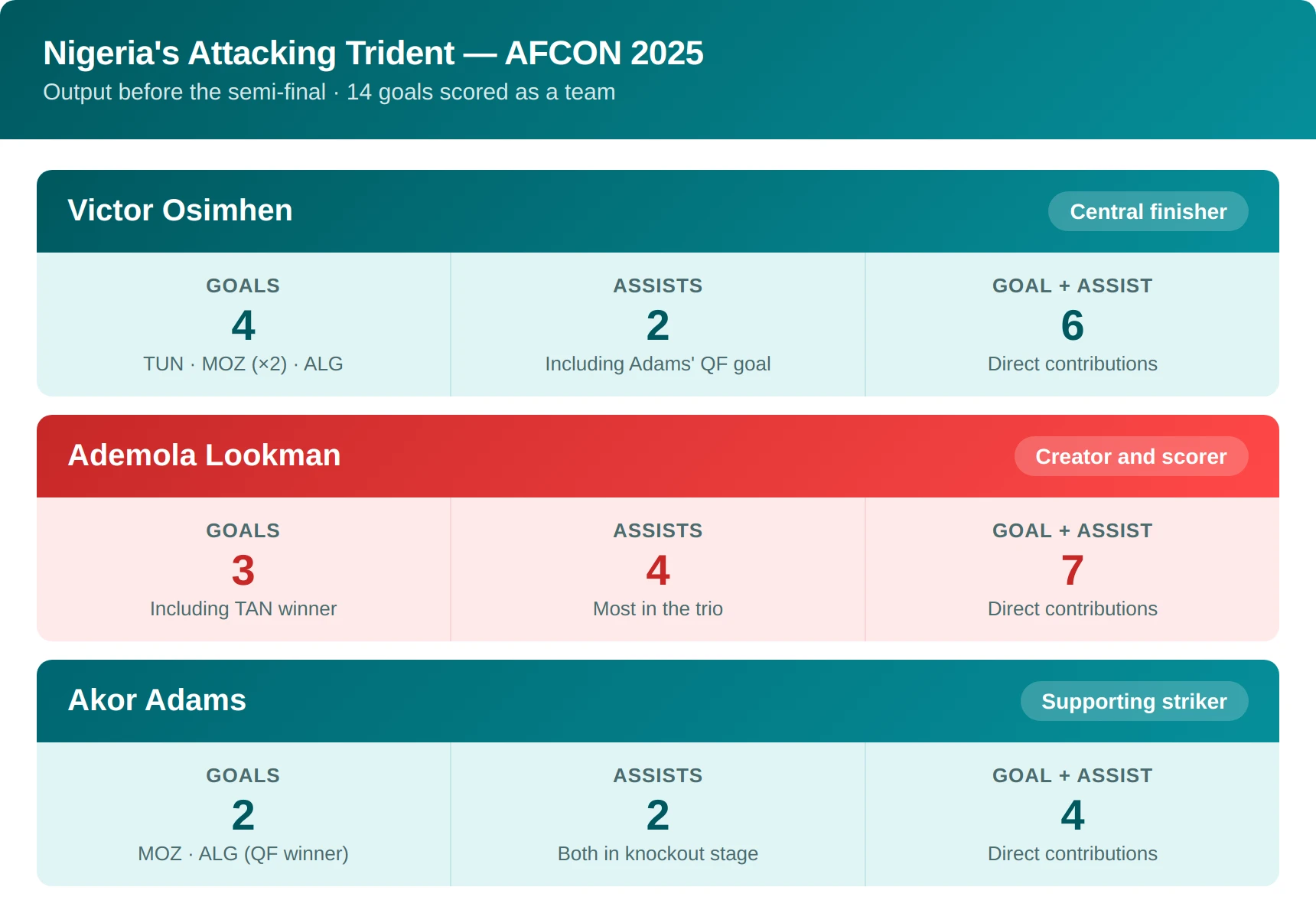 The balance is clear from the numbers. Nigeria were not waiting for Osimhen to decide every match alone. Lookman supplied goals and assists, while Adams added another finishing option through the middle.
Transition Play and Fast-Break Efficiency
Nigeria looked sharpest when they attacked before the opposing defence had time to reset. Lookman could carry the ball into space, Osimhen attacked the first central opening, and Adams followed the move as a second runner.
Among Victor Osimhen’s key games at AFCON 2025, the Algeria quarter-final showed his wider value most clearly. He scored the opener, then helped release Adams for the second in a 2–0 win. The sequence captured Nigeria’s strength in transition: once their forwards turned towards the goal, one quick combination could decide the match.
Midfield Support and Link-Up Play
The forwards needed quick service, and Alex Iwobi gave Nigeria that connection from midfield. His passing allowed Lookman to receive in useful areas and helped Osimhen and Adams attack defenders before they were fully organised.
Without that early supply, the front three were less comfortable. Their best attacks began with a pass that moved the game forward immediately, not with long spells of possession in front of a settled defensive block.
AFCON 2025 Performance Highlights
Nigeria’s tournament gathered momentum as it progressed. The group stage established Lookman and Osimhen as central figures, while the knockout victories over Mozambique and Algeria brought Adams fully into the attacking story.
Group Stage Dominance and Goal Output
Nigeria began with a 2–1 win over Tanzania on 23 December 2025, with Lookman scoring the winner shortly after the equaliser. Four days later, the Super Eagles defeated Tunisia 3–2 to secure their place in the knockout stage.
Lookman was central to the victory over Tunisia. He created Osimhen’s opening goal, supplied the corner for Wilfred Ndidi’s header and was named CAF Man of the Match. That performance added another strong entry to Ademola Lookman’s AFCON history with Nigeria. Once again, he was influencing tournament matches through finishing and creation.
Knockout Stage Impact and Key Moments
Nigeria’s front three peaked in the knockout rounds. Against Mozambique, Lookman scored, Osimhen struck twice, and Adams added the fourth in a 4–0 win that sent the Super Eagles into the quarter-finals. 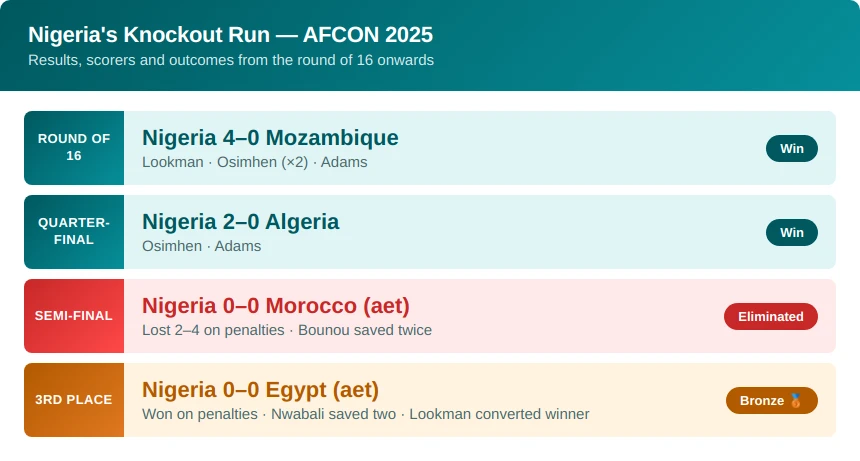 Osimhen’s goals this season at AFCON reached four when he scored again against Algeria. Wider Osimhen stats were even more significant because three of those goals arrived after the group stage, when every result decided whether Nigeria stayed in the competition.
Adams also delivered under knockout pressure. After scoring against Mozambique, Akor Adams’ CAF AFCON goal settled the quarter-final, giving Nigeria a two-goal advantage over Algeria to confirm their place in the semi-final.
Matches Where the Trident Was Most Effective
The trio were effective in different ways across Nigeria’s strongest matches:
- Tunisia: Showed Lookman’s ability to shape a close contest through delivery and movement.
- Mozambique: Showed the full attacking range of all three forwards.
- Algeria: Showed that Super Eagles could also win a tighter knockout match through one decisive combination.
Among Akor Adams’ most important games at the 2025 AFCON, the Algeria quarter-final stands out because his movement and finish completed Nigeria’s passage into the last four. That match also highlighted the value of the ‘Akor Adams Victor Osimhen partnership’. Osimhen drew attention, Adams made the supporting run, and Nigeria turned one clean exchange into the goal that ended Algeria’s hopes.
Chemistry, Strengths, and Weaknesses of the Trio
The trio combined for nine goals before the semi-final, but their threat depended on Nigeria finding them early. When the passing was quick, defenders had to manage Osimhen’s finishing, Lookman’s invention and Adams’ movement at once. When the tempo dropped, the front line became easier to separate from the rest of the team.
Osimhen as the Central Finisher
Victor Osimhen’s goals gave Nigeria a reliable reference point in the penalty area. He scored four times at AFCON 2025: once against Tunisia, twice against Mozambique and once against Algeria. His tournament was later recognised with a place in the tournament's Best XI alongside Ademola Lookman.
His movement mattered even when he did not score. Centre-backs had to protect the space directly in front of goal, which opened lanes for Lookman to create and for Adams to arrive beside him.
Lookman’s Dual Role as Scorer and Creator
Lookman’s four assists before the semi-final reveal the part of his role that mattered most. He was not only another goalscorer beside Osimhen; he was the attacker most likely to turn a promising move into a clear chance.
Ademola Lookman’s standout AFCON performance came against Mozambique, when his influence helped Nigeria take control of a knockout tie early. Lookman’s strongest games combined both sides of his work: he scored when defenders gave him room and created when their attention shifted towards Osimhen.
Akor Adams’ Off-the-Ball Movement and Pressing
Adams gave Nigeria energy beside Osimhen, pressing defenders and attacking the spaces created by the main striker’s movement. He did not need to dominate possession to affect the match.
Akor Adams’ goal stats show two goals. Both were after the group stage. Those carried extra value because they came in elimination matches, when Nigeria needed a second forward to turn pressure into results. His work was noticed from the opener, when Oliseh praised Akor Adams’ AFCON display for its energy and contribution beyond finishing.
What Went Wrong in the Title Push
The Super Eagles reached the semi-final with goals, confidence and two convincing knockout wins behind them. Morocco did not try to match that attacking pace. Instead, they reduced the space available to Nigeria’s forwards and turned the contest into a far more cautious game.
Tactical Adjustments by Opponents in Knockout Games
Morocco offered Nigeria fewer transition opportunities than Mozambique or Algeria. Their shape kept Lookman away from dangerous central areas, limited the early passes towards Osimhen and Adams, and made the Super Eagles work through crowded spaces rather than attack into open ground. 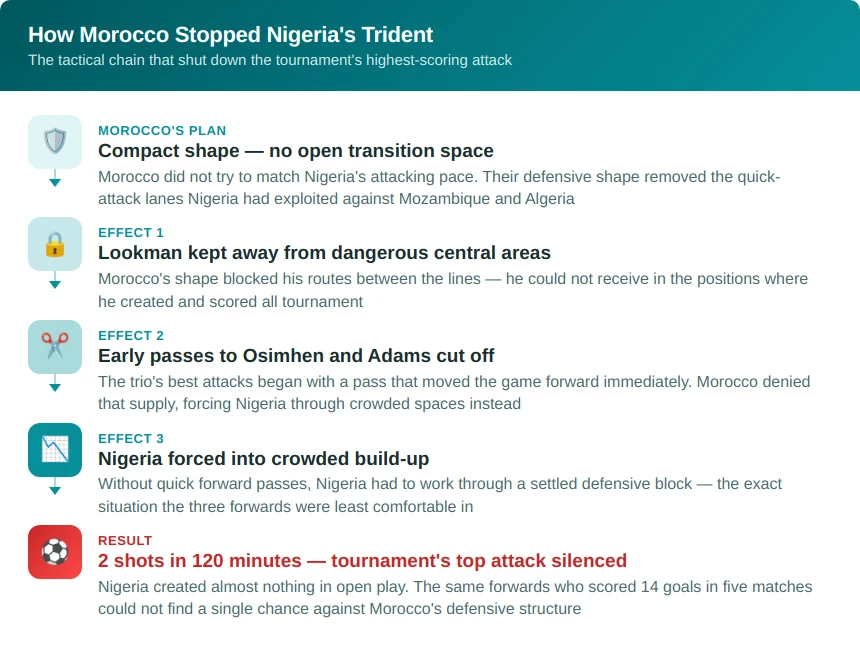 The semi-final finished 0–0 after 120 minutes before Morocco won the shootout 4–2. Yassine Bounou saved twice, sending the hosts through to their first AFCON final since 2004.
Missed Chances and Efficiency Under Pressure
Nigeria’s problem in the semi-final was not a long list of missed chances. Their forwards simply did not receive enough good opportunities in dangerous positions.
That was the real difference between the earlier knockout rounds and the Morocco match. The Super Eagles had been ruthless once openings appeared; in the semi-final, the openings themselves were missing.
Fatigue, Scheduling, and Squad Depth Issues
Nigeria played Mozambique on 5 January, Algeria on 10 January, Morocco on 14 January and Egypt on 17 January. Their final two matches also went to penalty shootouts, adding more physical and mental pressure at the end of the tournament.
Fatigue was part of the context, not the full explanation. Morocco faced their own demanding schedule, while Nigeria had to contest the semi-final without suspended captain Wilfred Ndidi, an absence that reduced their midfield control behind the attacking trio.
Betting and Analytical Insights From the Trio’s Performance
Nigeria scored 14 goals before the semi-final, the highest total by any team at that stage of AFCON 2025. Their attack then stalled against Morocco, where they failed to score and were limited to two shots across 120 minutes. For tournament analysis, that contrast matters: strong scoring form can disappear when an opponent reduces both space and shot volume. 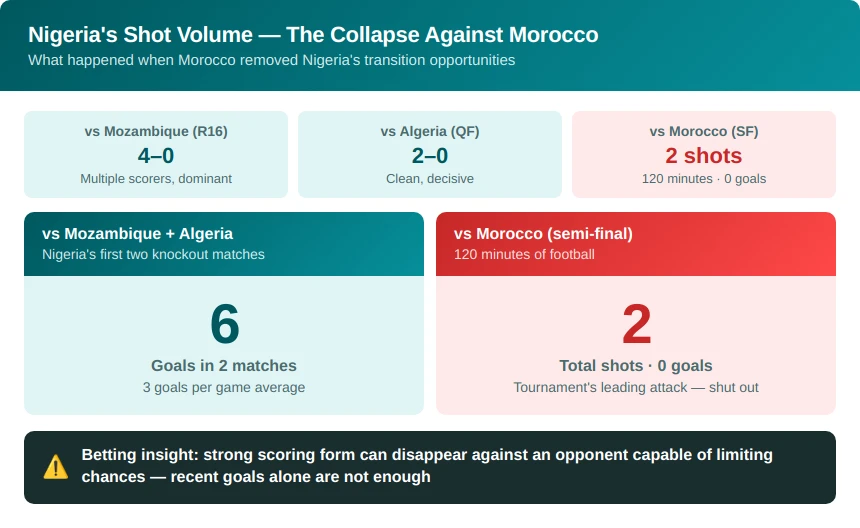
Importance of Multi-Scorer Teams in Tournament Markets
Nigeria reached the last four with nine goals shared between Osimhen, Lookman and Adams. For goals markets, that spread of scorers gave the team more than one route to a breakthrough: Lookman could finish or create, Osimhen attacked the central chances, and Adams added a second striker’s presence.
The knockout wins made that depth clear. Nigeria scored four times against Mozambique and twice against Algeria, with all six goals coming from the front three. The caution came in the semi-final, when Morocco restricted Nigeria to two shots in 120 minutes, and none of the three forwards found a goal.
Impact of Form Strikers on Match Outcomes
Nigeria’s most productive knockout performances came when the front three were directly involved in the scoring. Against Mozambique, Osimhen scored twice while Lookman and Adams added one goal each in a 4–0 win. Against Algeria, Osimhen scored and assisted Adams in a 2–0 quarter-final victory. That gave the trio six goals across Nigeria’s first two knockout matches, an average of three per game. The semi-final changed the picture completely: Morocco reduced the Super Eagles to two shots over 120 minutes and held the tournament’s leading attack scoreless.
For betting analysis, that is a more useful warning than recent form alone. A forward line can be in excellent form and still lose value against an opponent capable of limiting chances.
Overreliance on Attacking Output vs Defensive Stability
Nigeria’s medal run was not built on goals alone. After conceding during the group stage, the Super Eagles went through all four knockout matches without allowing a goal in open play or extra time: 4–0 against Mozambique, 2–0 against Algeria, and then goalless matches against Morocco and Egypt. That amounted to 390 knockout-stage minutes without conceding. It also meant the Super Eagles still had a route to bronze after the attacking output stopped: Stanley Nwabali saved two Egypt penalties in the third-place shootout, and Lookman converted the winning kick. The trio made Nigeria dangerous, but the clean-sheet run ensured the tournament ended with a medal.
.jpg)

.jpg)