


.jpg)
African football is defined by more than just talent; it is fuelled by deep-rooted rivalries that transcend the pitch. From the North African coast to the southern tip of the continent, these matches represent a battle for prestige, dominance, and local pride. 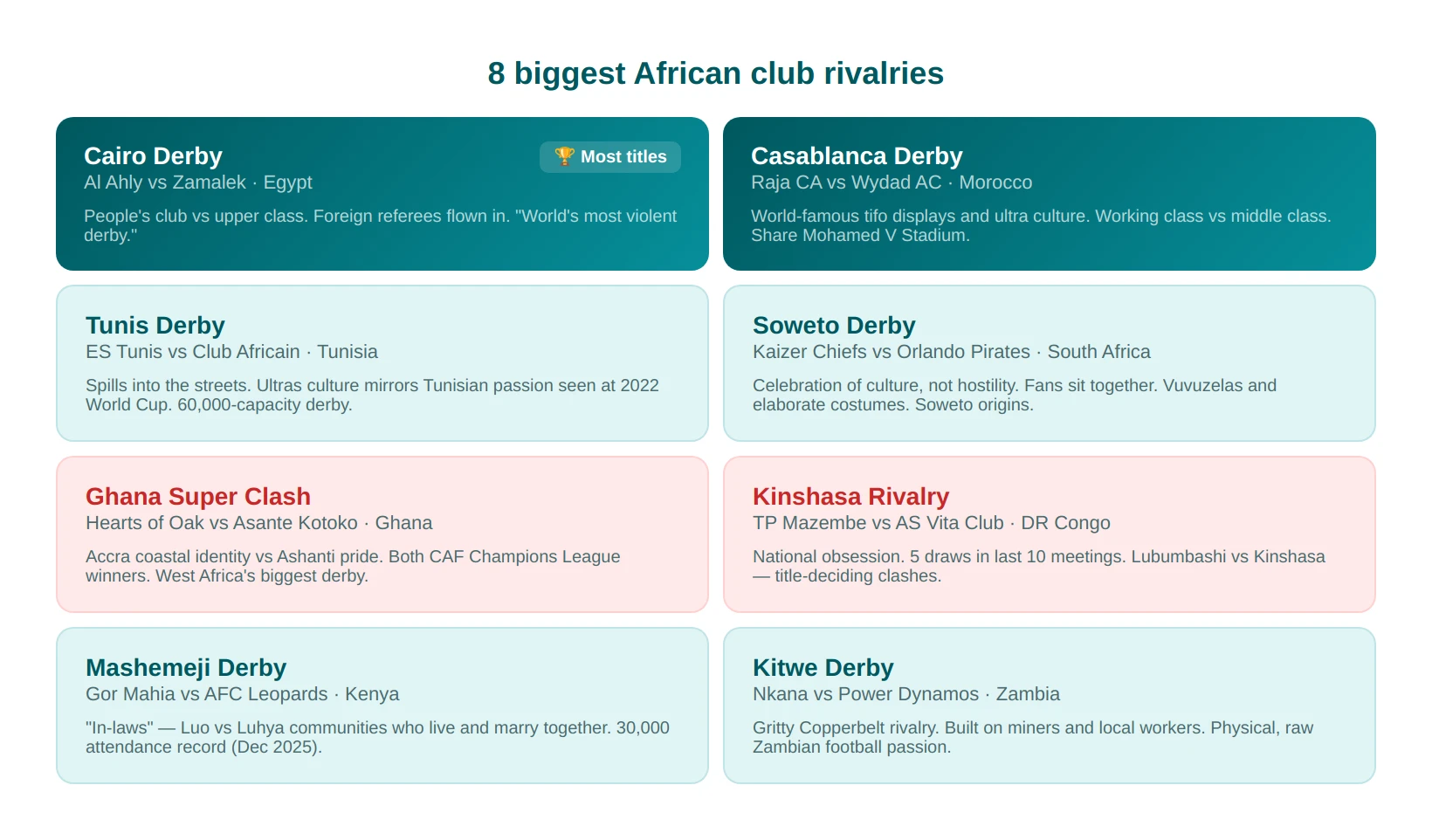
What Makes African Club Rivalries So Intense?
The intensity of a football derby in Africa stems from a mix of political history, social class, and neighbourhood identity. These matches aren't just games; they are traditions passed down through generations. For example, the geography and history of Al Ahly and Zamalek in Egypt mean that they are vying for dominance and bragging rights in Cairo. The presence of ultras, deafening chants, and colourful banners creates an atmosphere of pure passion that few other leagues in the world match. In South Africa, the Soweto derby (Kaizer Chiefs vs Orlando Pirates) sees the meeting of two clubs with Soweto origins, causing a celebration of culture in the middle of a footballing rivalry. The Soweto derby shows another side of African derbies, without the ultras, but every bit as passionate.
Cairo Derby - Al Ahly vs Zamalek
With a trophy cabinet full of CAF Champions League trophies, Al Ahly represents the "people’s club," while Zamalek is historically linked to the city's middle and upper classes. The Cairo Derby is arguably the biggest in football within the Arab world and Africa. The fierceness of the rivalry and history of the match led the Guardian to call it “The world’s most violent derby” in 2008.
This clash between Al Ahly (The Red Devils) and Zamalek (The White Knights) is a battle for dominance in the Egyptian Premier League. Played in massive stadiums filled with flares and smoke, the tension is so high that foreign referees are flown in to ensure neutrality.
Casablanca Derby - Raja CA vs Wydad AC
Played at the Stade Mohamed V, the rivalry splits the city between Wydad’s traditional middle-class base and Raja’s popular, working-class following, featuring intense atmosphere and displays from local ultras. Therefore, the Casablanca derby is a spectacle of football culture. Raja CA (The Green Eagles) and Wydad AC (The Red Castle) share the Mohamed V Stadium, but their supporters share nothing but animosity. This football derby is world-renowned for the choreographed tifo displays created by the ultras. The history of this match is steeped in heritage, making it a centrepiece of the Confederation of African Football’s calendar.
Tunis Derby - Espérance de Tunis vs Club Africain
The rivalries between these two sets of supporters in the Tunis derby spill over into the streets of Tunis, as both clubs fight for the right to call themselves the masters of the capital. This is part of a larger football culture in Tunis as captured at the 2022 World Cup in Qatar. Tunisian crowds caught the world’s attention with the clamour inside and outside the playing field as they supported their national side. The passion they show for football and other social, political, and justice issues captures the way the ultras behave in local Tunisian football, including in the Tunis rivalry between ES Tunis and Club Africain. The Tunis Derby pits Espérance de Tunis (Blood and Gold) against Club Africain (The Club of the People). This is the most prestigious football rivalry in Tunisia, where history and trophies are the primary currencies.
Soweto Derby - Kaizer Chiefs vs Orlando Pirates
In South Africa, Soweto is considered a cultural heartbeat of the country and its people. This significance is reflected in the role of Soweto as the origin of two of the biggest sides in the Premier Soccer League (PSL): Kaizer Chiefs and Orlando Pirates. The Soweto Derby is the ultimate sporting event. Kaizer Chiefs (Amakhosi) and Orlando Pirates (The Buccaneers) both originated from Soweto township. Unlike the North African derbies, which are hostile, the Soweto Derby is a massive celebration of football, though the passion on the field remains fierce. It is a match where legends are made and qualifications for continental tournaments are decided.
Ghana’s Super Clash - Hearts of Oak vs Asante Kotoko
The pride of the Ashanti people versus the Accra coastal identity makes every tackle a matter of national importance; they are the two biggest clubs in Ghanaian football. The Super Clash is the definitive football derby of West Africa. Hearts of Oak (Phobia) from Accra and Asante Kotoko (The Porcupine Warriors) from Kumasi represent a rivalry that is regional and tribal. This match showcases the best of Ghanaian football, with both clubs having a rich heritage of winning CAF titles:
- Hearts of Oak: Won the CAF Champions League in 1999/2000
- Kotoko: Won it in the 1969/1970 and the 1982/1983 seasons
Kinshasa Rivalry - TP Mazembe vs AS Vita Club
Not all derbies are city rivalries. The rivalry, DR Congo's biggest fixture, is one such case in point. It features TP Mazembe (The Ravens) and AS Vita Club (The Black Dolphins). The stats show that this clash is competitive. In their last 10 meetings, TP Mazembe have won four matches while Vita Club won 1, but five matches have ended in a draw, highlighting competitiveness.
While TP Mazembe is based in Lubumbashi, their frequent clashes with Kinshasa-based AS Vita Club for the league title have turned this into a national obsession. The dominance of these two clubs in the DR Congo ensures that their meetings are high-stakes affairs, attracting global attention.
Mashemeji Derby - Gor Mahia vs AFC Leopards
Not all derbies are fierce, involving ultras and the risk of violence. The “Mashemeji derby” provides a different iteration of derbies. “Mashemeji” is Swahili for “in-laws,” signalling the deep cultural and familial ties between the Luo (Gor Mahia) and Luhya (AFC Leopards) communities. Fans of the two teams live, work, and socialise together as friends and neighbours, in many cases having intermarried. The Mashemeji Derby is the most famous derby in football in East Africa. Gor Mahia (K’Ogalo) and AFC Leopards (Ingwe) represent the Luo and Luhya communities, respectively. The stadiums vibrate with traditional chants and the blowing of vuvuzelas. For these supporters, winning the derby is more important than the league title itself.
Kitwe Derby - Nkana vs Power Dynamos
The Kitwe Derby in Zambia is a gritty, industrial rivalry between Nkana (Kalampa) and Power Dynamos (Aba Yellow). Based in the Copperbelt region, these two football clubs have a history of intense physical matches. It is a rivalry built on the backs of miners and local workers, embodying the raw passion of Zambian football.
Why African Football Derbies Attract Global Attention
Derbies in African football include the best sides in their respective leagues, historically, trophy hauls, and fanbases. 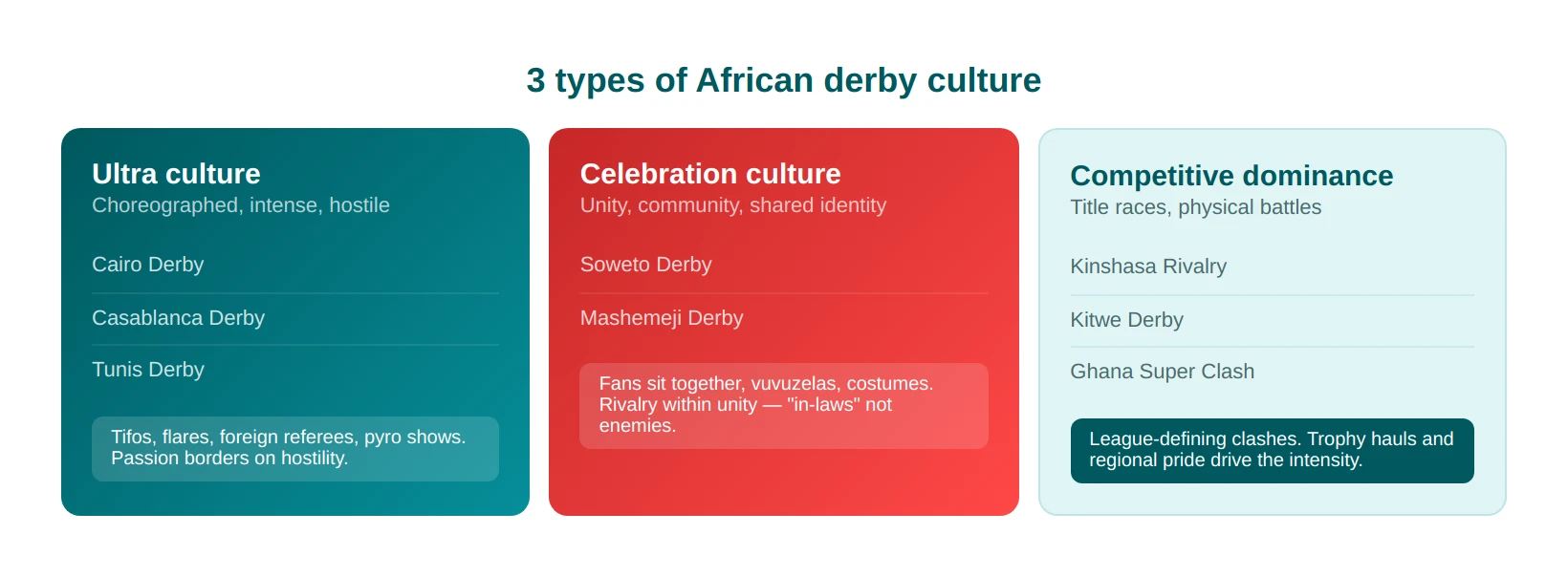 For instance, the Mashemeji derby involves the two sides with the biggest fanbases in Kenya. One example is the match between Gor Mahia and AFC Leopards on 7 December 2025, which set an attendance record with 30,000 fans packing Nyayo National Stadium. The same is the case in the Cairo derby; they are the two biggest clubs in the Egyptian League. Al Ahly FC has a market value of €37.05m, and Zamalek SC’s is €15.28 m. While Al Ahly has produced 21 national team players, Zamalek has created 14. Given this exposure, the two clubs and the derby they share attract international attention. The Tunis rivalry draws significant interest locally and regionally. Club Africain and ES Tunis share a city and a stadium, Stade El Menza. However, on derby days, the games are played at the bigger Stade Olympique de Rades, which holds a capacity of 60,000. This alone highlights the scale of interest and support during these matches. These rivalries attract global attention because they offer a raw, uncommercialised version of the sport. International scouts and fans watch these matches to see emerging legends and to witness the incredible atmosphere generated by supporters. These players have polished their skills in Belgium before upgrading to the top five European Leagues: this underscores the payoffs of scouting in Africa.
- Victor Osimhen: Royal Charleroi
- Terem Moffi: Moved to KV Kortrijk from Lithuania’s FK Riteriai
- Taiwo Awoniyi: On loan at Royal Excel Mouscron, and then moved to KAA Gent
- Victor Boniface: At Union SG after moving from Norwegian side Bodø/Glimt
As crown jewels of their respective leagues, derby football delivers sheer unpredictability and a high level of skills on display, making them "must-watch" events for any true fan of the game.
The Cultural and Social Impact of Club Rivalries in Africa
From the streets of Cairo, Tunis, Soweto, Accra, or Nairobi, the sport is a unifying phenomenon, with emerging football subcultures, especially among youngsters. For many young people, football represents an escape from their daily exertions and a place to channel their dreams of a better life. Broadcasters like SuperSport and Canal+ Afrique build their entire marketing calendars around these fixtures. A "Soweto Derby" or "Cairo Derby" attracts blue-chip sponsors (like banks and telecommunications giants) that might otherwise ignore smaller league matches. The traditions associated with these clubs, from specific banners to match-day rituals, are vital parts of the continent's cultural fabric. For example, the Casablanca Derby is known for some of the world's most elaborate Tifos and pyro shows. Fans of Raja and Wydad often arrive at the stadium over two hours early to coordinate massive visual displays and continuous singing that lasts long after the final whistle. In the Soweto Derby, unlike most fierce rivalries, fans of the Kaizer Chiefs and Orlando Pirates often sit together in the stands, a unique ritual of "unity within rivalry". The atmosphere is defined by the constant drone of vuvuzelas and fans dressed in elaborate, often humorous, costumes.