


.jpg)
George Weah had a legendary football career with top European clubs, such as AS Monaco, Paris Saint-Germain, AC Milan, Chelsea, Manchester City, and Olympique de Marseille. He is also a Ballon d’Or winner. He transitioned from his football career to become the President of Liberia and used his fame from being awarded the best player in the world to enter politics. 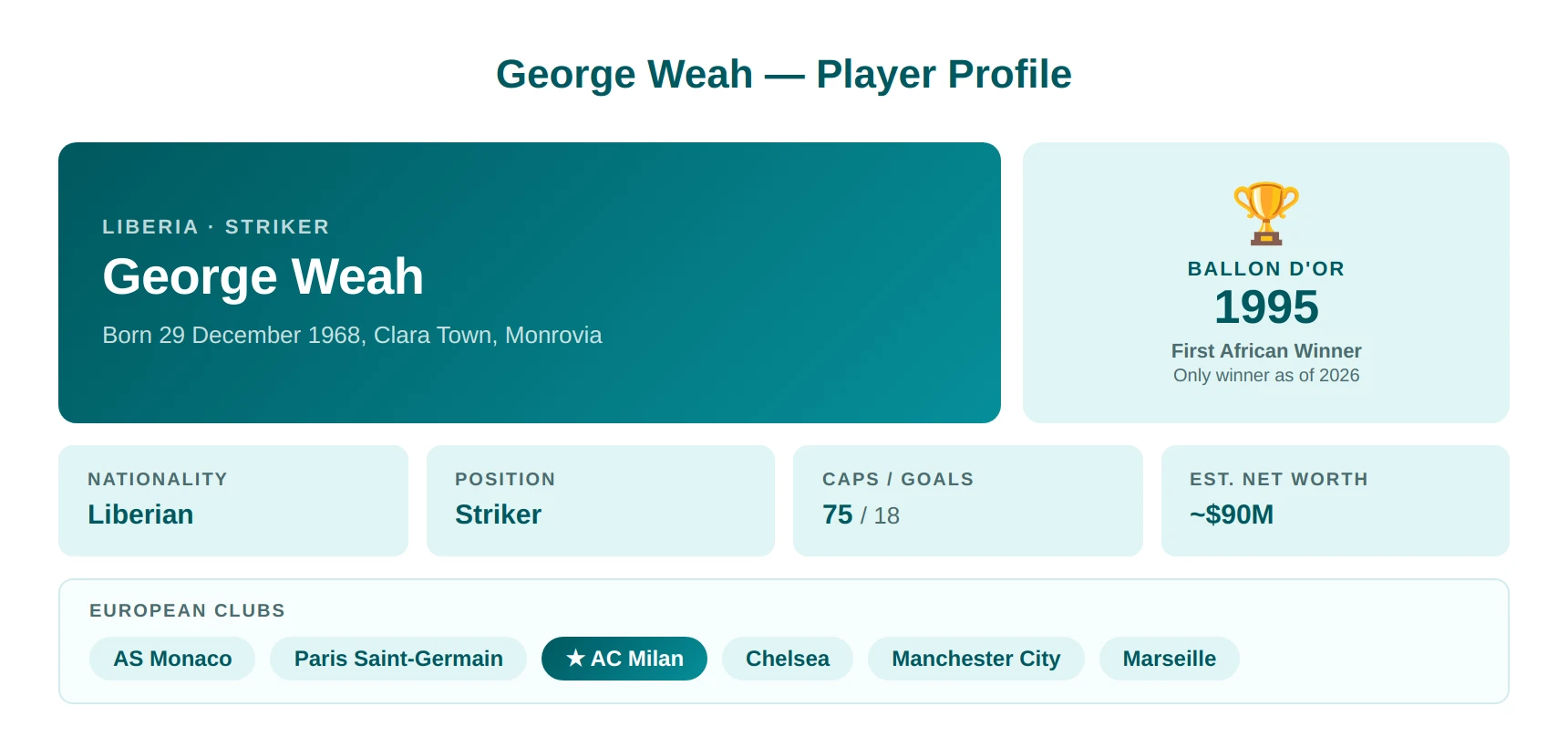
Early Life in Monrovia and the Rise of a Football Talent
Growing up in the Clara Town slum of Monrovia, George Weah faced the challenges of a difficult childhood, raised primarily by his grandmother. Despite these humble beginnings, his natural talent on the pitch quickly set him apart in the local Liberian leagues.
His early international reputation began to take shape while playing for clubs like Mighty Barrolle and Invincible Eleven. It was during this time that his fame as a powerful, clinical striker grew, catching the attention of scouts and eventually leading to his life-changing move to Europe.
George Weah’s Legendary Football Career in Europe
George Weah’s career in European football is marked by his consistency at the highest level. He eventually became the first and currently (as of April 2026) only African player to win the Ballon d'Or in 1995 while representing Paris Saint-Germain and AC Milan. Here are several George Weah awards and achievements:
| George Weah Clubs in Europe | Tenure | Major Trophies and Milestones | Individual Recognition |
|---|---|---|---|
| AS Monaco | 1988-1992 | Coupe de France (1991) | African Footballer of the Year (1989) |
| Paris Saint-Germain | 1992-1995 | Ligue 1 (1994), Coupe de France (1993, 1995), Coupe de la Ligue (1995) | African Footballer of the Year (1994), FIFA World Player of the Year (1995), UCL Top Scorer (1994–95) |
| AC Milan | 1995-2000 | Serie A (1995–96, 1998–99) | Ballon d'Or (1995), African Footballer of the Year (1995), African Player of the Century (IFFHS, voted 1996; awarded 2000) |
| Chelsea (Loan) | 2000 | FA Cup (2000) | Impactful debut with match-winning goals |
| Manchester City | 2000 | Brief spell in the Premier League | Scored 4 goals in 9 Premier League appearances (11 in all competitions) |
| Olympique de Marseille | 2000-2001 | Final European stint in France | 5 goals in 20 appearances |
Source: Transfermarkt
The Historic 1995 Awards: Ballon d’Or and Global Recognition
How good was George Weah? The year 1995 remains a crucial step in the life of George Weah, as he achieved a level of international respect never before seen for an African athlete. By winning the Ballon d'Or, he became the first player from Africa to receive the world’s most prestigious individual football awards. As of April 2026, he is still the only African player to achieve this prize. 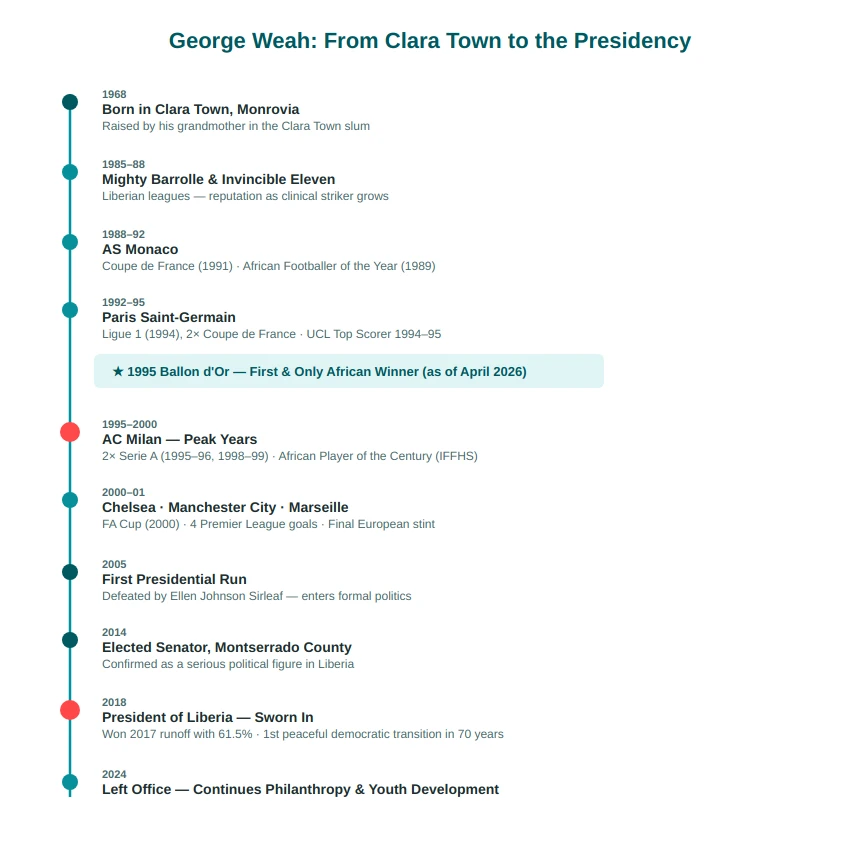 This achievement was a testament to his incredible talent and fame across Europe’s top leagues. Beyond the Ballon d’Or, he was also named the FIFA World Player of the Year and the African Footballer of the Year in the same season, a "triple crown" that solidified his reputation as a global icon.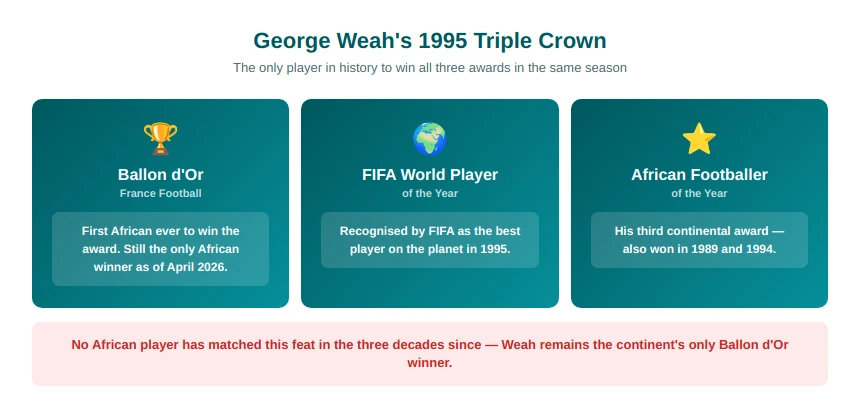
These awards did more than just honour his skill. They shaped future generations of athletes across the continent, proving that someone from Monrovia could reach the absolute pinnacle of global football success.
Representing Liberia and Inspiring a Nation Through Football
In total, George Weah made 75 appearances in FIFA-sanctioned matches for the national team, appearing in two as a substitute. He scored 18 times, proving his role as the national side’s Talisman. As the star of the national team, he didn't just play; he personally funded the squad’s travel, kits, and expenses during the height of the civil war.
This level of philanthropy and activism transformed him from a mere athlete into a national saviour. His influence on the pitch provided a rare sense of unity and inspiration for a nation struggling with conflict. Even when Liberia faced limited resources, Weah's talent and reputation ensured the "Lone Stars" remained competitive on the international stage.
From the Pitch to Politics: George Weah’s First Political Steps
In 2005, George Weah made his first major leap from the pitch to politics, a move driven by a desire for governance that reflected his long-standing activism. Despite his immense fame and international reputation, his initial entry into the elections was met with scepticism from the political elite, who questioned his lack of formal education.
Undeterred, Weah used his status as a symbol of motivation to connect with the youth and the marginalised in Liberia. His early advocacy focused on post-war reforms and national development. This period included his 2011 campaign for vice president alongside Winston Tubman under the Congress for Democratic Change, which introduced him formally into national politics. He later secured a major victory in 2014 when he was elected senator for Montserrado County, solidifying his role as a serious political figure and laying the groundwork for his eventual presidential win.
The Road to the Presidency of Liberia
The road to the Presidency of Liberia was a decade-long journey of persistence and political growth. After his initial 2005 defeat, George Weah did not retreat. He used the intervening years to bolster his reputation and formal education, proving his commitment to governance and reforms. 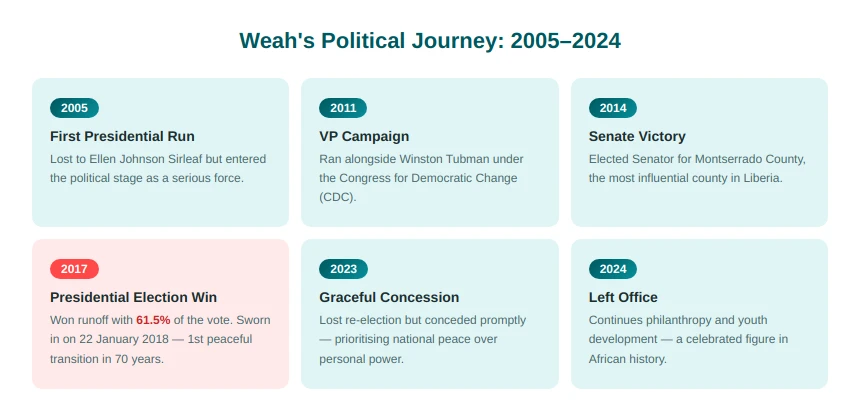 In the 2017 elections, representing the Congress for Democratic Change (CDC), Weah successfully leveraged his status as a rallying symbol and his immense fame to build a powerful coalition. He became George Weah, the president.
His victory marked a historic development in Africa, as it represented the first peaceful democratic transition of power in Liberia in over 70 years. This transition from the pitch to the executive mansion was secured with a decisive victory in the 2017 runoff, where Weah won 61.5% of the vote against Joseph Boakai’s 38.5%.
George Weah’s Leadership and Key Policies as President
George Weah's leadership and achievements were defined by his flagship Pro-Poor Agenda for Prosperity and Development (PAPD). These prioritised development through infrastructure, health, and education. While his governance realised notable achievements in physical development, his administration also faced significant challenges related to corruption, economic stability, and fulfilling long-standing promises of reform.
The question, therefore, is: “Was George Weah a good president”? The Weah presidency’s key policies included infrastructure, education, healthcare, and legal and social reforms:
- Infrastructure: Over 233km of primary roads and 116km of urban community roads constructed.
- Education: Free tuition was introduced for all students in public universities and colleges.
- Healthcare: Expansion of health services and facilities across Liberia.
- Legal and Social Reforms: Legislative and policy changes targeting inequality and governance.
How Football Fame Helped Shape Weah’s Political Influence
George Weah's status as a global sporting icon served as the primary engine for his political leadership in Liberia. His legendary football career, highlighted by the 1995 Ballon d’Or, provided him with a level of fame and international recognition that allowed him to bypass traditional political barriers and connect directly with the masses. Growing up in the Clara Town slum of Monrovia, Weah was seen as a “son of the soil”. His rise from humble beginnings to global stardom inspired young Liberians, creating a devoted youth base that propelled his electoral campaigns.
During the civil wars, his fame offered a rare source of national pride, and his philanthropy, such as personally funding the Liberian national team, established him as a leader who prioritised his country over personal gain. His international profile also enabled him to serve as a UNICEF Goodwill Ambassador, where he advocated for the disarmament of child soldiers and promoted education as a path to development.
George Weah’s Legacy in African Football and Liberian Politics
By winning the 1995 Ballon d’Or and multiple awards, Weah broke the "glass ceiling" for African players in Europe. His talent and fame at clubs like AC Milan and Paris Saint-Germain paved the way for future generations, cementing his reputation as the "King of Football" on the continent. His impact transitioned from the pitch to the presidency, where his governance focused on reforms for the poor. Even in his 2023 election concession, Weah added to his legacy by prioritising national peace over personal power, a rare act of diplomacy in regional politics.
After leaving office in 2024, Weah continued to play a role in Liberian public life through philanthropy and youth development initiatives, while remaining a celebrated figure in African football history. His 1995 Ballon d’Or win still stands as a landmark achievement for the continent, inspiring generations of African players to pursue careers in Europe’s top leagues.
He has also amassed a personal fortune. George Weah's net worth is estimated to be $90 million as of November 2023. His arc, from a young lad in Monrovia, a Ballon d’Or winner, and president of Liberia, has left a lasting imprint on the world of football and the politics of Liberia.