


In the world of sports betting, few markets are as popular as the over/under betting line, particularly the famous over/under 2.5 goals market. Whether you’re a beginner wondering “what does total match points mean?” or an experienced bettor looking for the best tips to refine your strategy, this guide will break down the meaning, mechanics, and strategies behind the over/under bet example soccer line. Unlike betting on who will win a football match, the over/under meaning focuses purely on the total number of goals scored. This makes it one of the most accessible and strategic betting options across sports like football, basketball, tennis, baseball, and cricket.
How Over 2.5 Goals Works - What Needs to Happen for the Bet to Win
When you place an over 2.5 goals bet, you are predicting that the game will feature three or more goals. The over 2.5 meaning is simple:
- Over 2.5 goals: The match must end with at least 3 goals (e.g., 2-1, 3-0, 2-2).
- Two Goals or More: If the match ends with 2 goals or fewer (e.g., 1-1, 2-0, 0-0), the bet loses.
This type of over/under bet example is popular because it doesn’t matter which team scores the goals. Whether it's Manchester City thrashing Liverpool or a tight match where both sides contribute evenly, like a close NBA game, the only thing that matters is the total bet outcome.
How Under 2.5 Goals Works
The opposite side of the market is the under 2.5 goals bet. Here, you are betting that the football game will end with two or fewer goals.
- Under 2.5 goals: The match must finish with 0, 1, or 2 goals.
- Three Goals or More: If the match ends with 3 or more goals, the bet loses.
This is often chosen in matches where teams are defensively strong, or where prediction models suggest a low-scoring affair.
Why Is the Line Set at 2.5 (Not 2 or 3)?
The o/u meaning of the 2.5 line is crucial. Bookmakers use the .5 system to eliminate the possibility of a draw or push. Since no team can score “half a goal,” the calculator code ensures that every bet either wins or loses.
- At 2 goals: The under 2.5 wins.
- At 3 goals: The over 2.5 wins.
This clarity makes the over/under betting market one of the best for beginners learning how to bet over/under.
Over 2.5 vs Under 2.5 - Key Differences
| Aspect | Over 2.5 Goals | Under 2.5 Goals |
|---|---|---|
| Outcome Needed | 3+ goals in the match | 0–2 goals in the match |
| Best Situations | Open, attacking teams | Defensive, cautious teams |
| Risk Level | Higher variance | Lower variance |
| Common Scores | 3-0, 2-1, 2-2 | 1-0, 0-0, 1-1 |
The choice between over or under depends on your prediction, team analysis, and sometimes even external factors like weather or injuries. Going by the 2025/26 English Premier League season record, as of 8 February 2026, Manchester United are the best Over 2.5 candidate. They’ve scored 46 goals (third highest in the Premier League) and conceded 36 times. Bournemouth, who have scored 41 and conceded 44 times, are also very good candidates for Over 2.5. On the flip side, Arsenal (49 goals scored and 17 conceded) and Manchester City (49 goals scored and 23 conceded) only offer an Over 2.5 goals edge going forward, but their defences are strong. Along these lines, Wolves (16 goals scored and 48 conceded) and Burnley (25 goals scored and 49 conceded) do not offer an attacking edge, but their poor defensive record is a boon for over 2.5 goals, providing a roadmap on how to win over and under bets.
Key Factors That Influence Over/Under 2.5 Outcomes
Several elements shape whether a match goes over or under the 2.5 line: Team tactics Attacking vs defensive styles. For example, when an attacking side like Manchester City, the top scorers after 24 matches in 2025/26, face the league’s worst defence in West Ham, who conceded 48 goals in that period, the likelihood of Over 2.5 goals is elevated. West Ham are also more defensive under Nuno Espírito Santo, which can invite sustained pressure. The Man City vs West Ham match on 20 December 2025 ended in a 3-0 win for the Citizens, highlighting this point. League trends Some leagues like the Bundesliga average more goals than others. Among the big 5 leagues in Europe, Bundesliga tops the average goals per game (3.2 GPG), followed by the Premier League (2.9 GPG), Italy (2.8 GPG), Ligue 1 (2.7 GPG), and La Liga (2.6 GPG). 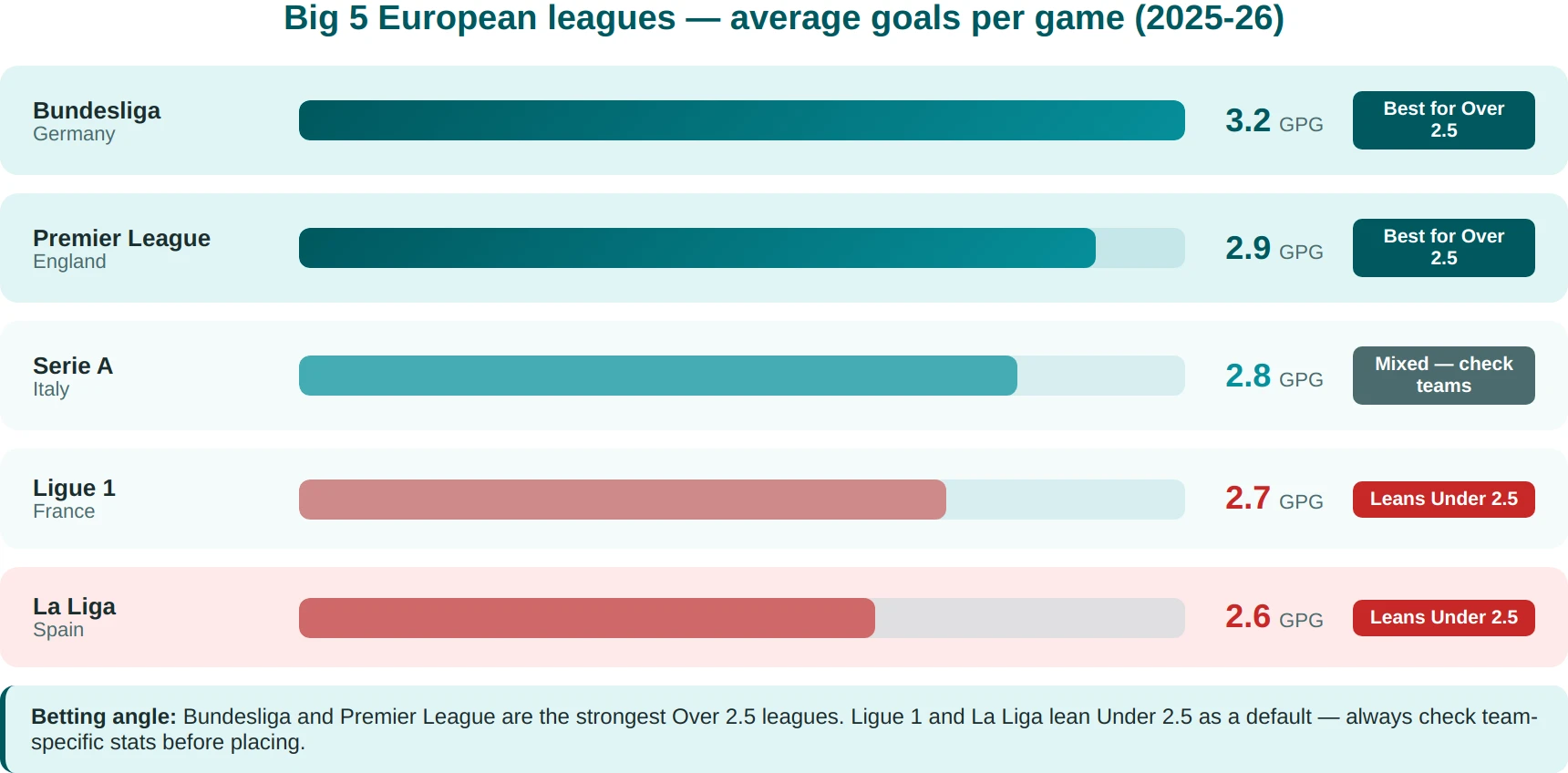 Therefore, Bundesliga and EPL are better suited to Over 2.5 goals bets, whereas Ligue 1 and La Liga are best for the Under 2.5 goals, following this trend line. Player form Injuries to strikers or defenders can swing outcomes. A good example is Manchester City, who have scored 49 goals after 24 matches in the 2025/26 season. Their top striker, Erling Haaland, is the leading scorer in the Premier League as of 8 January 2026. He’s notched 20 goals and 5 assists (0.89 goals per 90). An injury to Haaland could adversely affect Man City’s cutting edge in attack, affecting their Over 2.5 goals credentials. On the player side, having in-form players on the pitch, like Igor Thiago (16 goals for Brentford), Antoine Semenyo (12 goals), Hugo Ekitike (10 goals), and Joao Pedro (9 goals), adds to the Over 2.5 goals likelihood. The opposite effect is true (Under 2.5 goals) for the absence of these players for their respective teams. Game importance Top-of-the-table clashes, finals, or relegation battles often see fewer goals. For instance, the last time Arsenal faced Man City on 21 September 2025, in the Premier League, the match ended in a 1-1 draw. Another example is a top-of-the-table clash between Arsenal and Liverpool on 8 January 2026, which ended in a 0-0 stalemate. Sports data calculators Bettors use prediction models and code-based calculators to estimate probabilities. Note that such calculators provide projections based on trends; they cannot 100% predict the dynamics of a unique football match.
Common Mistakes With Over/Under 2.5 Bets
1. Ignoring Context: Betting Blindly Without Considering Team Form
In the 2025/26 season, for example, Bayern Munich (Bundesliga) have hit Over 2.5 goals in 100% of their matches so far. Bettors who ignored this attacking trend and backed Under 2.5 purely on odds missed out repeatedly. Sevilla have only hit Over 2.5 in 67% of games, showing more defensive balance. Betting blindly on “Spanish football = low scoring” would ignore Sevilla’s actual form. The lesson here is to always check team-specific stats rather than relying on league stereotypes.
2. Confusing Over/Under Meaning with BTTS (Both Teams to Score)
An instance showing this mistake is West Ham United in the Premier League. West Ham have seen Over 2.5 goals in 70% of matches, but not all of those games had BTTS. A 3-0 win cashes Over 2.5, but loses on BTTS. On the flip side, Marseille hit Over 2.5 in 63% of games, but many ended 2-1 or 3-0, meaning BTTS was not guaranteed. The lesson here is, don’t confuse total goals markets with BTTS. They measure different outcomes.
How to Use Team Stats Effectively
1. Avoid Misusing Examples: Assuming Past Games Always Predict Future Outcomes
Every match occurs in the context of the preceding match, but each game has its own conditions. Balancing these two aspects is crucial to avoiding this mistake. For instance, Barcelona have hit Over 2.5 in 81% of matches this season. Bettors who assume “Barcelona always scores heavily” may forget that injuries or tactical changes can reduce output. A surprise package, Heidenheim hit Over 2.5 in 74% of matches. Bettors relying only on last season’s defensive record would miss this shift. The thing to remember is that past performance is useful, but current season context (injuries, tactics, transfers) matters more.
2. Avoid Overestimating “Big Teams”
While big sides in the 2025/26 season typically outscore their opponents, this is not a given in a football match. For example, Tottenham Hotspur have hit Over 2.5 in 65% of matches, but not every game is high-scoring. A 1-0 win against a defensive opponent still cashes for Spurs but loses for Over 2.5 bettors. On the flip side, Eintracht Frankfurt hit Over 2.5 in 68% of matches, but bettors who assume “Bundesliga = goals always” may lose when Frankfurt grind out 1-0 wins. Remember, even **“**big teams” can produce low-scoring matches depending on opponent tactics, similar to how NBA or NFL teams sometimes win defensively. The takeaway from these common mistakes is that in the 2025/26 season, bettors must avoid blind assumptions. Always check current team stats, distinguish between Over/Under vs BTTS, and remember that even big clubs can produce low-scoring matches depending on context.
Over/Under 2.5 vs Other Goal Lines
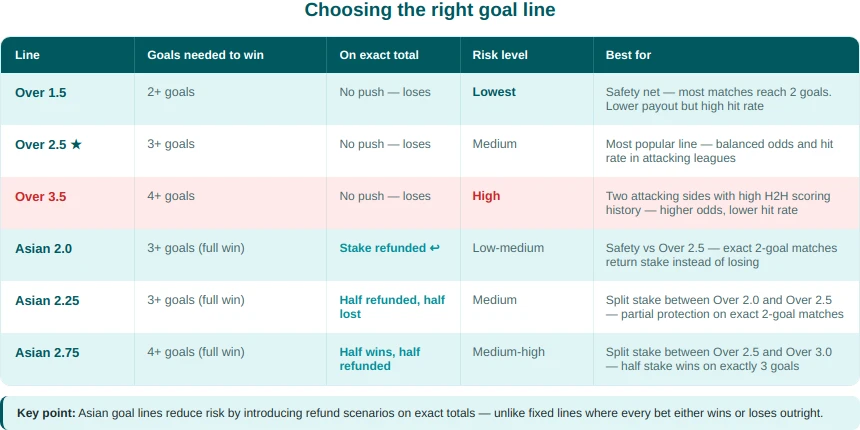
The over/under betting market doesn’t stop at the 2.5 line. Bettors often compare it with other goal lines like 1.5, 3.5, or even Asian goal lines like 2.0, 2.25, and 2.75. Understanding these differences can help you choose the right market for your prediction, risk appetite, and betting strategy.
Over 1.5 vs Over 2.5
Over 1.5 goals requires just 2 goals in the match. This is considered safer because most professional football matches average at least 2 goals. However, the odds are lower, meaning the payout is smaller compared to over 2.5 meaning. For instance, in the 2025/26 Premier League season, the match featuring Manchester United vs Manchester City on 17 January 2026 ended 2-0 to the home side. In this game, bettors on Over 1.5 won, but those on Over 2.5 lost.
Over 2.5 vs Over 3.5
Over 3.5 goals requires 4 or more goals. This market is riskier, but the odds are higher, offering bigger rewards. In the 2025/26 Bundesliga Eintracht Frankfurt match against Borussia Dortmund on 9 January, the scoreline was 3-3 at full-time. Bettors on Over 2.5 won easily, but those on Over 3.5 also cashed in with higher odds. On the other hand, a 2-1 scoreline would win Over 2.5 but lose Over 3.5. The takeaway here is that Over 3.5 is best used when two attacking teams meet, or when historical head-to-head stats show high-scoring trends.
Asian Goal Lines (2.0, 2.25, 2.75)
Asian goal lines add complexity and flexibility, allowing bettors to reduce risk or split outcomes. Unlike fixed lines such as Over 2.5, Asian lines introduce refund or half-win scenarios when matches land on exact goal totals.
Over 2.0: If the match ends with exactly 2 goals, your stake is refunded. For instance, when Roma vs AC Milan ended in a 1-1 draw on 25 January 2026, there was a refund on Over 2.0.
Over 2.25: Your bet is split between Over 2.0 and Over 2.5. If the match ends with 2 goals, half your stake is refunded, and half is lost. If 3+ goals are scored, you win fully. When Juventus beat Napoli 3-0, bettors on Over 2.25 won the bet fully. If the game had ended 2-0, the bettors on 2.25 could get half of their stake refunded and lose half.
Over 2.75: Your bet is split between Over 2.5 and Over 3.0. If the match ends with 3 goals, half your stake wins, and half is refunded. If 4+ goals are scored, you win in full. In the English Premier League, Man City beat West Ham 3-0, and bettors on Over 2.75 won half their stake (on Over 2.5) and got half refunded (on Over 3.0).
The lesson about Asian lines is that they are excellent for risk control. They allow bettors to hedge against exact-score outcomes and reduce losses compared to traditional fixed lines.
Choosing the Right Line for Risk Control
Smart bettors use risk calculators and sports tips to decide whether to play over/under 2.5 or shift to Asian goal lines. The choice depends on: Confidence in prediction If your analysis strongly suggests a high-scoring match like Bundesliga fixtures where teams average over 3 goals per game, then taking Over 2.5 or even Over 3.5 may be justified. On the other hand, if you’re less confident, shifting to Over 1.5 provides a safety net, since most matches reach at least two goals. Odds value The odds value is crucial. Sometimes, bookmakers offer inflated odds on Over 2.5 because the market expects a tight game. If your research shows otherwise, this can be a profitable opportunity. Conversely, if odds on Over 1.5 are too low, it may not be worth the risk. Game importance The context of the match matters. High-stakes games like top-of-the-table clashes, finals, or relegation battles often see fewer goals, as teams play cautiously. In contrast, mid-season fixtures or matches between attacking sides are more open.