


%20Tips_%20High%20risk%2C%20high%20reward.jpg)
Mastering the Half-Time/Full-Time (HT/FT) market requires more than just picking a winner; it demands an understanding of match flow, physical fatigue, and tactical shifts. These bets offer higher odds than standard 1X2 markets, but a single red card or a second-half substitution can overturn the half-time scoreline entirely.
What Is HT/FT Betting?
The HT/FT meaning in betting is simple: you predict the match result at both the interval (half-time) and the final whistle (full-time). Unlike a standard half-time or full-time bet on a single outcome, HT/FT requires predicting two stages of the match, making it more complex but potentially more rewarding. For example, a half-time/full-time bet could be Home/Home, meaning the home team should lead at half-time and win at full-time. Other combinations include Draw/Home, Away/Draw, or Home/Away, each reflecting different patterns of play.
How HT/FT Markets Work: Rules and Payouts
Bookmakers offer HT/FT markets with higher odds than traditional match outcome bets. The rules are straightforward:
- Predict the result at half-time.
- Predict the result at full-time.
- Both must be correct for the bet to win.
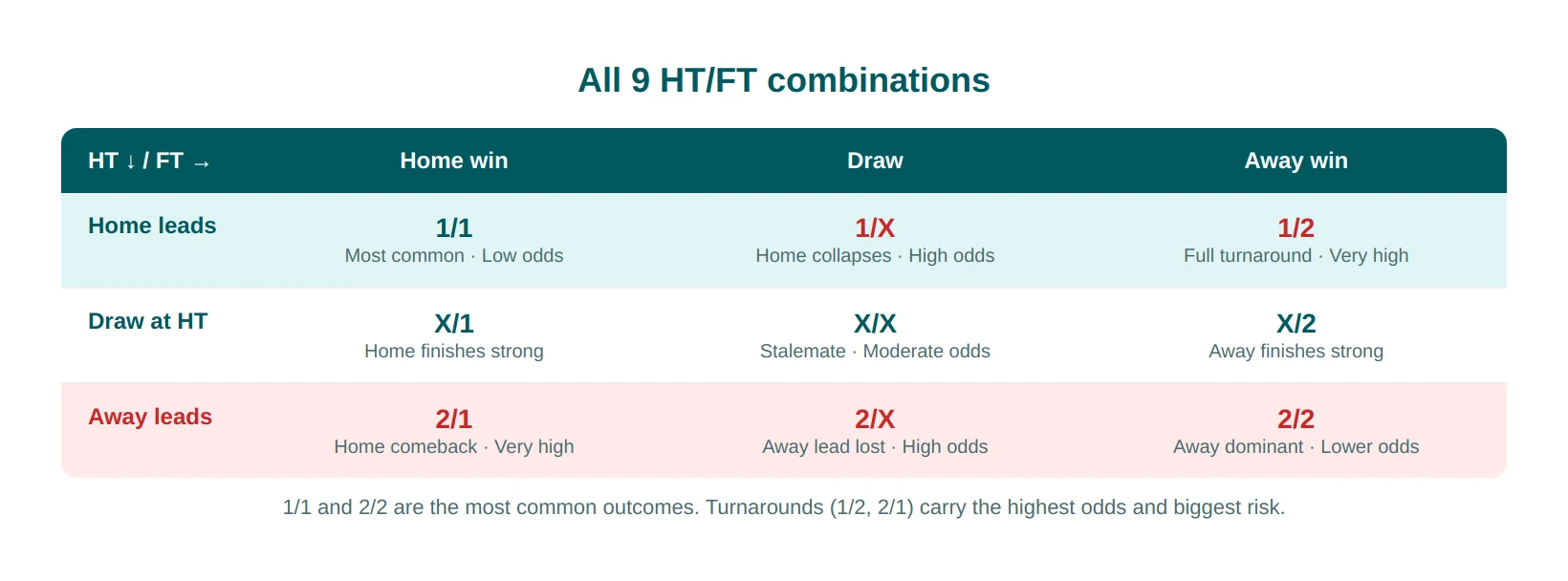 For example, in the West Ham vs Wolverhampton Wanderers match on 10 April 2026, a straight West Ham win (1X2) is priced at 1.8 on 22Bet. The HT/FT Home/Home – West Ham leading at the break and winning at full-time – carries odds of 2.7. The difference reflects the added difficulty of being correct at both the interval and the final whistle.
Why HT/FT Is Considered High Risk
Momentum, tempo, and possession can shift rapidly due to injury, fatigue, or tactical changes like substitutes or changes in formation: For example, in the 2025/26 season, Chelsea have demonstrated the impact of red cards on match flow and outcomes. On 20 September 2025, Robert Sanchez was sent off in the fifth minute against Manchester United after a foul on Bryan Mbeumo, and the Blues went on to lose 2-1. A week later, Trevoh Chalobah was dismissed against Brighton for a foul on Diego Gomez. Chelsea were leading at the time but were pegged back and eventually lost 3-1. A red card before half-time forces the affected side into a more defensive formation regardless of the scoreline, making the full-time outcome almost impossible to predict from the pre-match HT/FT call.
When HT/FT Offers High Reward
In HT/FT betting, “high reward” means targeting the less obvious outcomes, such as Draw/Home, Away/Home, or Home/Away, rather than the predictable Home/Home on a heavy favourite, which usually pays very low odds. These less conventional outcomes carry a higher risk but also significantly higher payouts. A clear illustration comes from the FA Cup clash between Wrexham and Chelsea on 7 March 2026. Despite the Blues being overwhelming favourites, the match ended 1-1 at half-time and 2-2 at full-time. The Draw/Draw HT/FT outcome paid around 7.50 (13/2) compared to Chelsea’s pre-match win odds of just 1.25 (1/4). This shows how HT/FT markets can deliver outsized returns when the game doesn’t follow the expected script. So when is a high-reward HT/FT call worth taking? It depends on team tendencies:
| Draw/Away | A defensively strong away side that regularly holds opponents to first-half stalemates but grows into the game and wins late. |
|---|---|
| Home/Away | A fast-starting home side that often fades in the second half against a counter-attacking opponent. |
| Draw/Home | A home team that struggles to break down stubborn defences early but eventually wears them down after the break. |
Key Strategies for HT/FT Betting
Removing guesswork from HT/FT betting requires a strong understanding and application of the home/away half-time/full-time meaning to develop a strategic approach. This relies on knowledge of the leagues, teams, historical data, and the ability to avoid common pitfalls.
Analysing First-Half vs Second-Half Strengths
Teams that dominate the first half and teams that finish strongly follow different statistical patterns – and identifying which applies is the foundation of any HT/FT strategy. After 30 rounds of the 2025/26 EPL season, Manchester City lead the half-time table with 20 wins, eight draws, and two losses, making them the most reliable Home/Home HT/FT selection in the league. At the other end, Wolverhampton Wanderers have led at half-time just twice, while losing the first half on 14 occasions. Backing them to lead at the break is one of the highest-risk HT/FT calls in the division.
Reading Team Play Styles and Tactics
Different tactical approaches and styles influence HT/FT in distinct ways:
| Style | HT/FT Pattern | Representative Team in the 2025/26 Season | Supporting Stats |
|---|---|---|---|
| Possession-based / Attack-minded | Often lead at half-time and full-time (Home/Home, Away/Away). They dominate early and sustain pressure. | Manchester City | 20 half-time leads in EPL 2025/26; 81 attacking threat rating. |
| Defensive / Low Block | Frequently hold 0-0 at half-time but concede later (Draw/Home or Draw/Away). | Atletico Madrid | Conceded only 12 first-half goals across 29 La Liga games in 2025/26 and 16 in the second half. |
| Counter-attacking | Tend to produce low-scoring first halves, then strike late (Draw/Away or Home/Away). | Arsenal | Mikel Arteta’s men have the largest discrepancy between HT and FT goals. They’ve scored 21 goals in the first half and 40 goals in the second. |
| Set-piece Specialists | More likely to break deadlocks late, turning Draw/Draw into Draw/Home. | Arsenal | 22 set-piece goals as of 1 March 2026, decisive in tight matches. |
Using Historical HT/FT Data
Context matters beyond the half-time table. For example, Aston Villa have salvaged six wins and one draw from 16 deficits in 2025/26 (as of 30 March 2026). Sunderland have turned around five wins and four draws from 19 losing positions. The fewest comebacks have been posted by Newcastle, who have recovered just once from 14 matches in which they trailed, losing the other 13. A history of comebacks supports higher-risk HT/FT calls for bettors. Time in the lead is another indicator. For example, Man City have led 55.4% of their matches in 2025/26, with Manchester United (44.7%), Arsenal (44.3%), and Bournemouth (39.5%) also posting strong numbers. As a result, the Cityzens are likely to lead at HT and FT, whereas the Gunners can be level or even behind at HT but winning at FT.
Avoiding Common HT/FT Pitfalls
Few things derail a betting strategy faster than the chaos of a derby or a big clash: early red cards, wild momentum swings, and unpredictable outcomes. Heightened emotions and high stakes lead to early red cards, such as Robert Sanchez’s fifth-minute sending off in the Manchester United vs. Chelsea clash at Old Trafford on 20 September 2025. Overestimating comeback potential is a trap because betting on a turnaround just because the odds are high is not always justified by the probability of it occurring. For example, in Arsenal’s 2-3 loss at home to Manchester United on 25 January 2026, there was an expectation of a home comeback that did not materialise, despite the Gunners being the more in-form side at the time.
HT/FT Tips for Top Leagues and Matches
There is no guarantee in betting, including HT/FT. However, there are approaches you can leverage to improve your chances slightly, depending on the leagues, competition, or derby matches.
Big 5 European Leagues
In the EPL, Home/Home HT/FT bets on Man City and Arsenal against the bottom five (Nottingham Forest, Tottenham, West Ham, Burnley, and Wolves) have a strong 2025/26 hit rate. Both sides have won the majority of those fixtures from the first whistle. The same pattern holds in La Liga (Barcelona and Real Madrid against the bottom five) and Serie A (Inter Milan, AC Milan, and Napoli against Lecce, Verona, and Pisa).
Cup and Knockout Matches
Giant killings are especially appealing in cup and knockout matches. The standout match of the 2025/26 season was in the EFL Cup, where lowly Grimsby Town held Manchester United to a 2-2 draw and prevailed 12-11 in the penalty shootout to eliminate the Red Devils from the EFL Cup on 27 August 2025. Cautious first halves are common in knockout ties, particularly in two-legged fixtures where teams protect a clean sheet. Draw/Home and Draw/Away are the most common HT/FT outcomes in these matches – factor this into selections rather than defaulting to Home/Home or Away/Away.
Derbies and High-Intensity Fixtures
Michael Carrick’s return to Old Trafford as interim manager in January 2026 started with a stunning 2-0 win in the derby against Manchester City. Form-wise, the Cityzens were on a better trajectory while also involved in the title chase. But they were outplayed in that match, managing only one shot on target and relying heavily on Gianluigi Donnarumma's saves to avoid humiliation. Sunderland's 1-2 win over Newcastle on 22 March 2026, despite Newcastle competing in the Champions League and Sunderland being newly promoted, is a reminder that form tables and squad quality are unreliable guides in derby fixtures. The HT/FT call on either side carries a higher risk than a standard league match.
Lower Leagues and Underdog Opportunities
Lower leagues offer consistent underdog value. On 14 March 2026, Championship leaders Coventry lost 1-2 at home to seventh-placed Southampton. In their last three outings (as of 29 March 2026), second-placed Middlesbrough in the Championship lost 0-1 at home to 18th-placed Charlton, drew 1-1 at home to 16th-placed Bristol City, and were held to a 0-0 draw by 19th-placed Blackburn Rovers. In lower leagues, the gap between top and bottom is narrower than in the top flight, making Away/Away or Draw/Away HT/FT calls on unfancied sides a legitimate strategy when form suggests the favourites are vulnerable.
Statistical Indicators That Predict HT/FT Outcomes
While many bettors focus on the final score, HT/FT markets rely on identifying teams that "fade" or "finish strong." 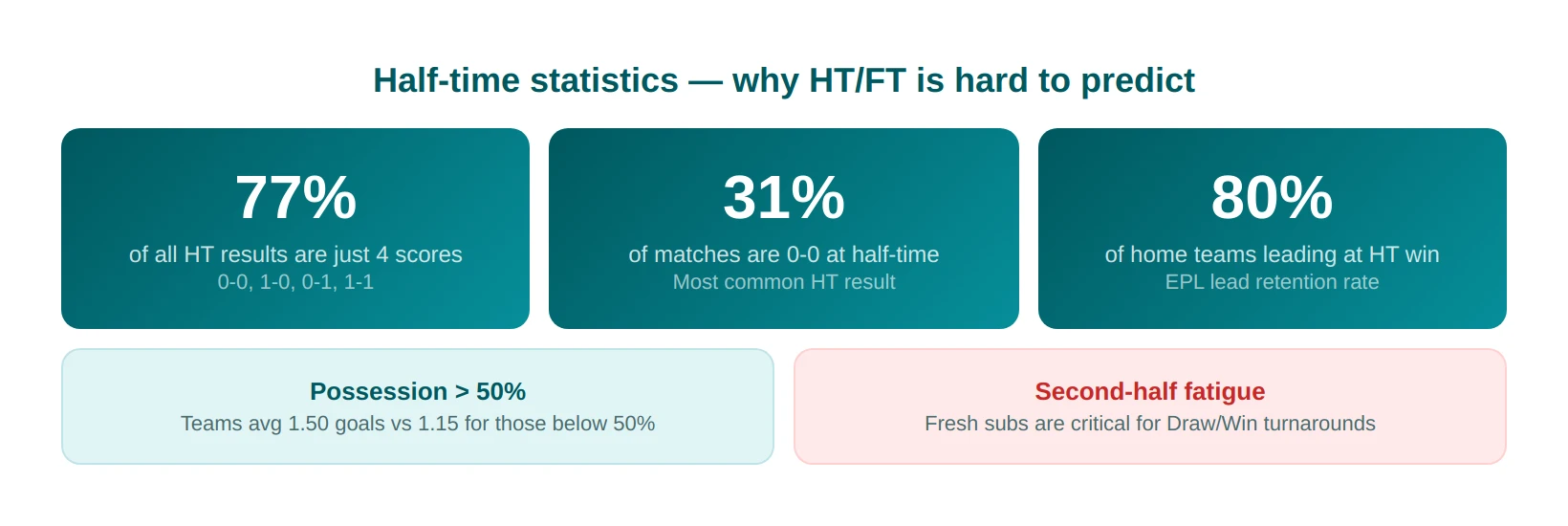 Teams maintaining over 50% possession score more goals (avg. 1.50 vs 1.15 for those below 50%). However, possession shifts in the second half as losing teams increase running effort to salvage a result. High-intensity actions (sprints and accelerations) are higher in the first half. Fresh legs from tactical substitutions in the second half are critical for "Draw/Win" or "Loss/Win" turnarounds, as fatigue leads to defensive lapses late in the game. At half-time, results are highly concentrated; just four scores (0-0, 1-0, 0-1, 1-1) account for 77.27% of all half-time outcomes, with 0-0 being the most common at around 31%. On lead retention, in top leagues like the EPL, roughly 80% of home teams leading at half-time go on to win the match.
Bankroll for High Risk Bets
Effective bankroll management is the single most critical factor for surviving high-risk markets like Half-Time/Full-Time (HT/FT). Because these bets carry higher odds and a lower hit rate, standard unit sizing leads to rapid depletion of funds during inevitable losing streaks.
- Standard unit size is a core bankroll allocation principle. Professionals risk 1% to 2% of their total bankroll on a single standard bet. For volatile markets like HT/FT or longshots, reduce stake size to 0.5% or lower per match.
- Consider allocating a fixed "high-risk pool" (such as 10% of your total bankroll) specifically for longshots or accumulators to protect your core capital.
- Establish a daily or weekly "stop-loss" limit; if you reach this threshold, stop betting immediately to avoid "chasing" losses with emotional, high-stakes wagers.
- Never double your bet size after a loss to "get back to even," as high-variance markets sustain long negative runs.
- Use multiple sportsbooks to find the best odds; even small differences (like 5.50 vs. 6.00) impact long-term ROI.
- Log every bet, including the rationale and result, in a spreadsheet to identify if your HT/FT strategy is actually producing returns over time.
Using Live Betting with HT/FT Markets
While pre-match HT/FT bets are locked in, live betting allows you to "layer" your position. If you backed Home/Home and the home team is winning 1-0 at the 35th minute but looks exhausted or is pinned in their own half, hedge with a live Draw or Away full-time result. Real-time indicators provide crucial information. Metrics such as passes per defensive action can signal fatigue, while dangerous attacks over the last 10 minutes highlight momentum. Tactical substitutions often reflect shifts in intensity, and yellow cards to centre-backs can expose potential defensive vulnerabilities. A top-tier team is drawing 0-0 at half-time against a parked bus. If their Expected Goals (xG) is high but they haven't scored, the live odds for Draw/Win peak right at the start of the second half. In another scenario, an underdog leads 1-0 at HT but has conceded 15+ shots. The physical toll of defending, coupled with the opponents’ increasing intensity, increases the risk of conceding in the second half. This is the perfect time to eye a Home/Away or Home/Draw turnaround. A red card for the leading team before half-time completely resets the HT/FT probability. Live markets overreact, creating value if the leading team has a strong defensive structure. Use apps like Flashscore or SofaScore to see the "Attack Momentum" graph. A sustained spike usually precedes a goal.
Common Mistakes to Avoid
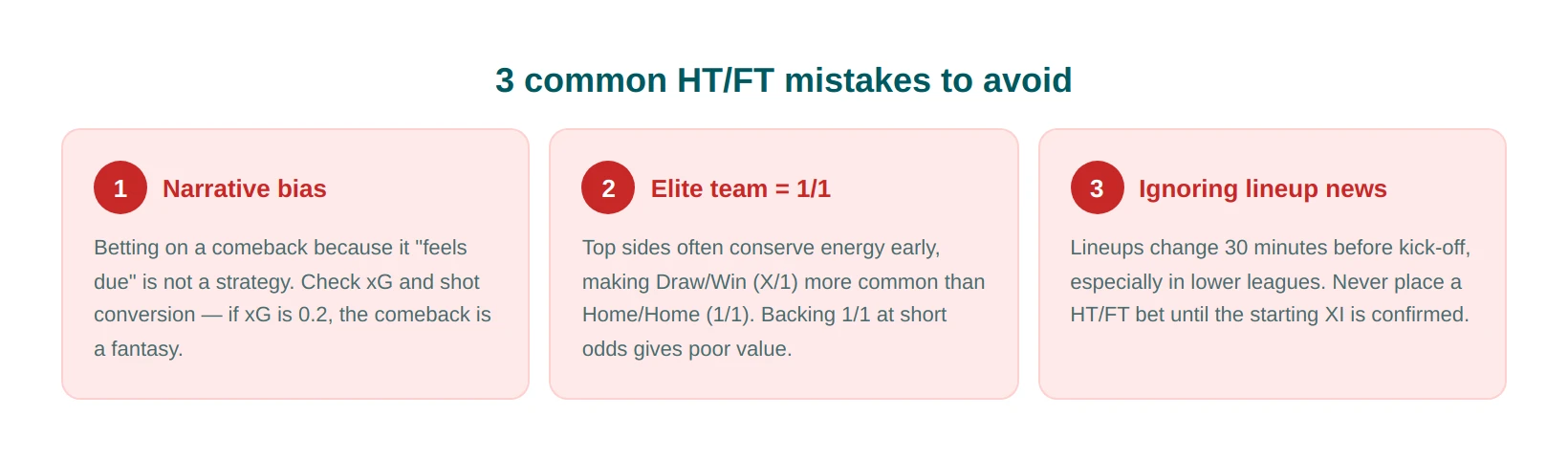 Betting because a team "feels due" for a comeback is a recipe for disaster. HT/FT markets are priced on math, not narratives. Use xG and Shot Conversion rates. If a team trails at half-time but has an xG of 1.5+, they are statistically likely to score in the second half. If their xG is 0.2, the "feeling" they’ll come back is just a fantasy. Just because a top-tier team is playing doesn't mean they'll lead at both HT and FT. Elite teams play conservatively in the first 30 minutes to tire out opponents, leading to many Draw/Win (X/1) outcomes rather than Home/Home (1/1). Betting the 1/1 at low odds offers terrible value if the team is a "second-half specialist." Lineups in lower leagues change 30 minutes before kick-off. Never place a high-risk half-time/full-time bet until the official starting XI is announced. Check for "late scratches" or tactical shifts (e.g., switching from a back-4 to a back-5).