



Record-Breaking Betting Wins Across Africa
Bonnie Kamau’s Historic Mega Jackpot Win
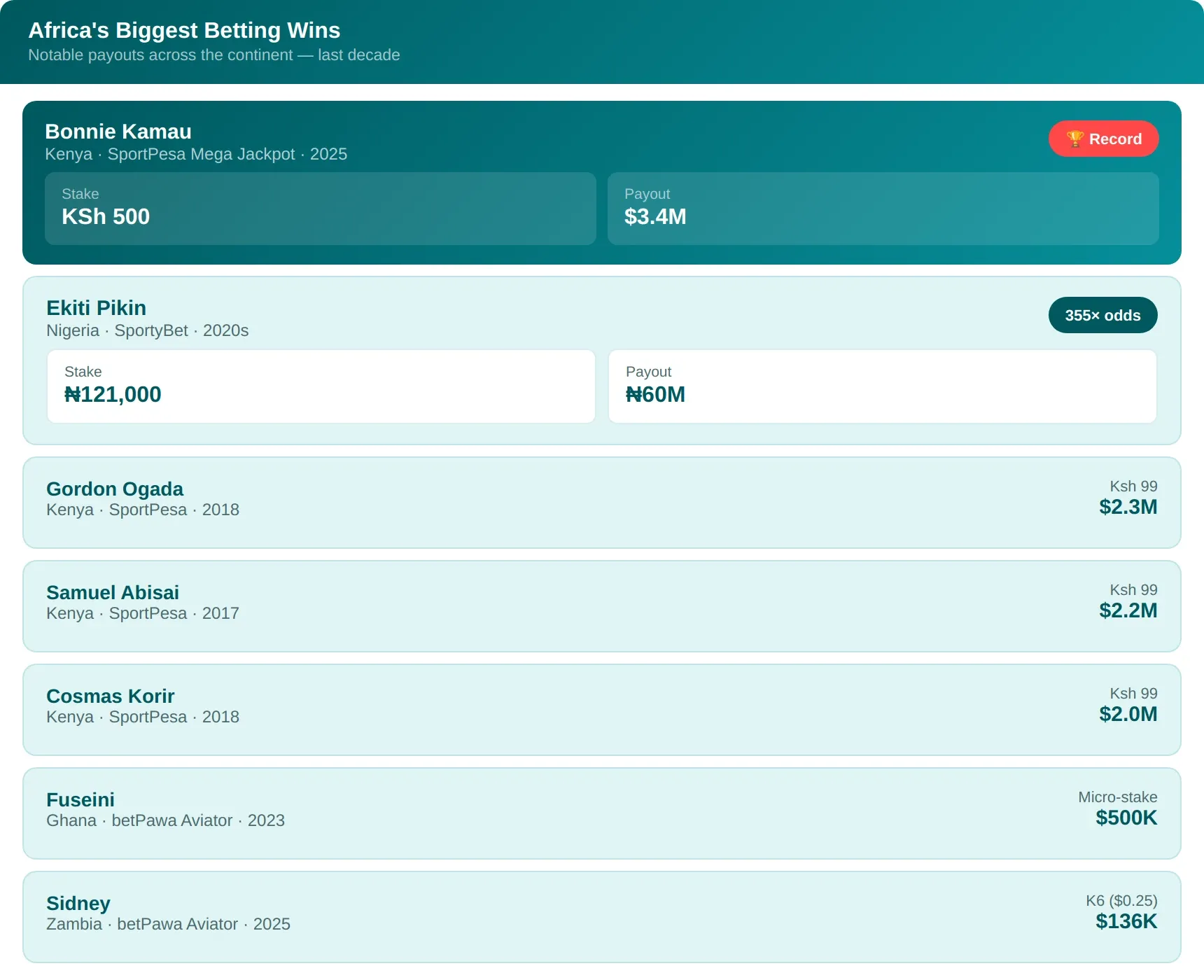
The historic KSh 424,660,618 ($3.4 million) victory by Bonnie Kamau on 3 August 2025 stands as one of Africa’s biggest betting wins. His mega jackpot prediction required a perfect 17/17 1X2 outcome, a feat that pushed the boundaries of what the platform’s payout limits could sustain.
Bonnie Kamau, an accountant working in the transport industry, correctly predicted the outcomes of all 17 football matches to shatter previous records. His achievement as the KSh 424 million jackpot winner set a new benchmark in Kenya’s betting history. Kamau's historic win unseated long-standing records in the mega jackpot’s hall of fame:
- Gordon Ogada: (Ksh. 230,742,881 in 2018).
- Samuel Abisai: (Ksh. 221,301,602 in 2017).
- Cosmas Korir: (Ksh. 208,733,619 in 2018).
Ekiti Pikin’s High-Odds Multi-Million Victory
Legendary Nigerian punter Ogunlade Mayowa Isaac, widely known in Nigerian betting circles as Ekiti Pikin (or Mayor of Ekiti), engineered one of West Africa's most famous multi-bet victories by turning a stake of ₦121,000 into a staggering ₦60 million.
He leveraged a massive odds accumulator with a combined 355 odds to pull off the high-risk miracle. Ekiti also won ₦37.4 million after betting ₦50,000 at over 600 odds. His betting strategy turned modest stakes into multi-bet returns that Africa celebrates.
Other Notable Big Wins in African Betting History
The Story of Bonnie Kamau’s Life-Changing Jackpot
From Small Stake to KSh 424 Million Payout
The story of Bonnie Kamau's mega jackpot win, a victory of KSh 424.6 million on 3 August 2025, illustrates how a minimal stake yields a record payout. Kamau spent a total of KSh 500. He split this into five distinct 17-game combinations costing KSh 99 to KSh 100 each. His single winning combination yielded exactly KSh 424,660,618. When calculated, this created a final payout ratio of 849,321 times his total invested capital. 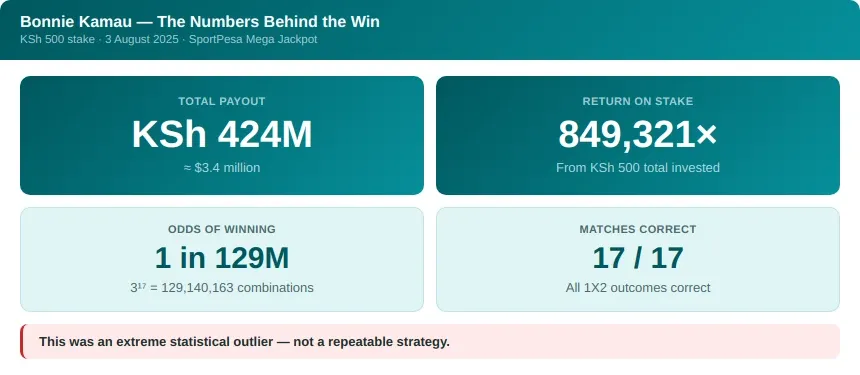
Correctly Predicting 17 Matches in a Mega Jackpot
Bonnie Kamau secured his historic KSh 424,660,618 payout by correctly predicting the 1X2 match outcomes (Home Win, Draw, or Away Win) for all 17 football matches on his slip, rather than guessing exact final scores (e.g., 2-1 or 0-0).
In the structure of a 17-match mega jackpot, predicting exact scores for those matches would introduce a nearly impossible mathematical hurdle. Players must, instead, accurately forecast the final match result after 90 minutes of play.
What Made This the Biggest Win in Kenya’s History
Kamau’s KSh 424.6 million win shattered the previous national record held by Gordon Ogada (KSh 230.7 million) by an unprecedented KSh 193.9 million margin. Kamau's win drew national attention and reignited interest in jackpot betting across East Africa.
Ekiti Pikin’s High-Risk, High-Reward Betting Strategy
Staking Small Money on Extremely High Odds
The high-reward blueprint engineered by Ekiti Pikin has redefined West African betting culture. His staking plan for big wins involved leveraging variance and volatility. Despite the appearance of rigorous sports analytics and tactical bankroll management, this win - like many other major wins - came down to luck.
Turning ₦121,000 into Multi-Million Returns
Ekiti Pikin’s iconic ₦121,000 stake produced a ₦60,000,000 payout, a feat that stunned Nigerian bettors. For East African readers, this stake translates to roughly KSh 9,200-11,000, based on an exchange rate of ₦1 = KSh 0.076-0.09 (August 2025 market average).
To put this in perspective, KSh 9,200-11,000 is close to a week’s wage for many Kenyan service workers or the monthly rent for a modest Nairobi apartment. In other words, Ekiti Pikin risked what would typically represent a significant portion of disposable income.
This contextualises the scale of his risk appetite: while the payout was extraordinary, the upfront stake was far from trivial in local terms.
The Role of Risk Appetite in Extreme Wins
In sports betting, distinguishing between an analytical edge and a lucky streak requires tracking the concept of Expected Value (EV). For instance, Bonnie Kamau’s KSh 500 stake split across five slips produced one winning ticket worth KSh 424,660,618. The EV of his wager is expressed as: 𝐸𝑉 = (𝑃𝑟𝑜𝑏𝑎𝑏𝑖𝑙𝑖𝑡𝑦 𝑜𝑓 𝑤𝑖𝑛𝑛𝑖𝑛𝑔 × 𝑃𝑎𝑦𝑜𝑢𝑡) − (𝑃𝑟𝑜𝑏𝑎𝑏𝑖𝑙𝑖𝑡𝑦 𝑜𝑓 𝑙𝑜𝑠𝑖𝑛𝑔 × 𝑆𝑡𝑎𝑘𝑒). The calculated figure reveals odds of roughly 1 in 129 million ((3^17 = 129,140,163)). The expected return on a single ticket was only a fraction of a shilling, far below the stake.
In simple terms: if the chance of winning is tiny, the expected return is almost always lower than what you staked - no matter how big the payout looks. His win was therefore not the result of positive EV but an extreme statistical outlier. This illustrates how risk appetite and variance blur the line between a calculated edge and pure chance.
What These Wins Reveal About Betting Behaviour in Africa
The Appeal of Life-Changing Jackpot Bets
The psychological appeal of progressive jackpots or high-odds accumulators lies in their ability to offer life-altering payouts. Beyond the headline payouts, sportsbooks sweeten the deal with jackpot bonus prizes, such as consolation rewards for near misses or secondary payouts for partial accuracy. These reinforce the belief that every ticket carries transformative potential.
These wins are statistical anomalies, but they also reflect a broader transformation in African consumer psychology. As traditional economic pathways face rising inflation and shifting employment landscapes, sports betting across the continent has transitioned from a casual entertainment activity into a highly calculated, speculative pursuit of financial freedom.
Influence of Social Media and Viral Winning Stories
Platforms like X (formerly Twitter) amplify Ekiti Pikin's posts, where his predictions and betting slips attract thousands of followers. By transforming solitary gambling into a communal spectacle, viral winning stories trigger psychological and financial impacts on the betting ecosystem.
Influencer predictions gain massive traction through retweets, quote tweets, and trending hashtags, exposing hundreds of thousands of users to specific match codes and bet combinations. When users see the detailed, high-odds of Ekiti Pikin games, such as "winning slips" posted by influencers, it provides instant validation and cultivates a highly engaged community of followers eager to replicate the success.
The Psychology Behind “One Big Win” Thinking
The allure of a single transformative jackpot is not just about money - it is deeply rooted in how our brains process risk, reward, and probability. This phenomenon is described as the “one big win” mindset, where players fixate on the possibility of a life-changing payout rather than the far more likely outcome of repeated losses.
Availability heuristic makes dramatic, memorable wins easier to recall than the slow grind of routine losses, and the near-miss effect tricks the brain into coding a close loss as a “proximal win,” encouraging continued play even in defeat. Meanwhile, modern betting apps employ gamification techniques:
- Flashing lights
- Celebratory sounds
- Animations
All of these are designed to trigger dopamine releases, even when the player is experiencing net losses.
Key Lessons for Bettors From These Big Wins
Luck vs Strategy in Long-Shot Betting Markets
High-variance strategies: These demand massive capital reserves to survive hundreds of consecutive losses between rare wins. True discipline treats stakes as completely lost capital the moment the bet is placed.
High odds: These inherently reflect an extremely low mathematical probability of occurring. Winning requires surviving consecutive independent events where the probability of total loss is near 100%.
True strategy: These rely on finding mispriced odds, not simply picking outcomes with high payouts. A 355-odds ticket implies less than a 0.28% chance of winning before accounting for the bookmaker's margin.
Successful long-term survival: These require betting tiny fractions of a bankroll, 1% to 2% per wager. Large stakes like ₦121,000 on long shots accelerate the path to "Gambler's Ruin" if bankroll reserves cannot sustain deep losing streaks.
Importance of Bankroll Management and Discipline
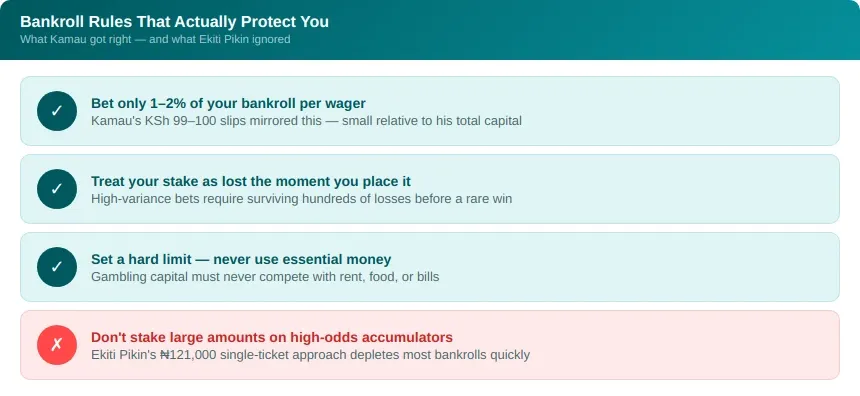
Restricting standard wagers to 1-2% of total capital protects against catastrophic losing streaks.
This principle is illustrated by Bonnie Kamau’s KSh 500 stake, which he split into five slips of about KSh 99-100 each. His habit of keeping wagers small relative to his overall bankroll mirrors the 1-2% guideline, showing how disciplined staking preserves capital until a rare jackpot hits.
By contrast, Ekiti Pikin’s ₦121,000 stake on a single high-odds accumulator demonstrates the opposite approach: a large, concentrated bet that magnifies risk and reward. While it produced a legendary ₦60 million payout, using this approach consistently would deplete most bankrolls quickly.
Fractional Kelly staking optimises growth by scaling bets strictly according to edge size and specific odds. Setting hard financial limits ensures gambling capital never competes with essential life expenses.
Understanding Odds vs Probability Reality
Bettors must distinguish between fixed odds and jackpot betting. Misjudging variable payouts leads to false expectations.
Calculating true probability requires dividing 1 by the decimal odds (1/Odds × 100). Odds never reflect pure probability; they are artificially lowered to guarantee a profit margin (the overround).
2.00 odds imply a 50% chance of success, but the real-world probability is always lower due to the house cut. As odds scale linearly (e.g., from 10.00 to 100.00), the true probability of winning declines exponentially.
Risks Behind Extreme Betting Wins
Survivorship Bias in Viral Jackpot Stories
Bettors look to Bonnie Kamau, Gordon Ogada, and Ekiti Pikin as standards of the betting world. They are examples of success, motivating potential winnings. This phenomenon highlights the survivorship bias. Only highlighting winners distorts distribution and expectancy. Most bettors face long-term losses vs rare big wins. This is a textbook case of survivorship bias in gambling, where attention is focused on the rare jackpot winners while the overwhelming majority of losing tickets remain invisible.
Social algorithms aggressively amplify winning slips, creating a curated timeline of extreme outliers. As a result, bettors mistake a statistical anomaly for a repeatable, skill-based strategy. This reinforces the illusion that massive wins are common rather than extraordinary exceptions.
The constant exposure to viral wins artificially inflates a player's perceived probability of winning, creating an illusion of favourable odds. For every viral multi-million Naira betting ticket, millions of identical stakes finish out of the money, funding the single outlier payout.
Long-Term Losses vs Rare Big Wins
Who wins in the long-term, the punter or the house? Bookmaker margins dictate that every unit wagered has an immediate, mathematically guaranteed average loss percentage. High-variance betting creates steep, prolonged drawdowns that rapidly outpace a player's capital reserves.
Bettors disproportionately overvalue extreme long shots, suffering higher loss rates compared to backing favourites. The Law of Large Numbers ensures that as bet volume increases, individual luck decays and total returns strictly converge toward a net loss.
Misconceptions About “Easy Money” Betting
What do mega jackpot wins teach punters? Extreme wins highlight the delicate balance of risk-to-reward ratio betting, where probability vs luck in sportsbooks defines outcomes. Without bankroll discipline, chasing life-changing stakes quickly leads to gambling addiction concerns.
New bettors confuse deep sports fandom with predictive statistical accuracy, ignoring that bookmaker algorithms process thousands of variables. Viewing a predictable outcome post-match creates a false impression that the result was obvious and easily foreseeable.
Some bettors believe that analysing past team data eliminates the inherent, unquantifiable randomness of live sporting events. Labelling any wager a guaranteed win ignores the reality that sports always carry a non-zero probability of an upset.
What Bettors Should Really Take Away
Wins like Bonnie Kamau’s mega jackpot or Ekiti Pikin’s massive multi-leg slips are extreme statistical outliers. Marketing materials and social algorithms broadcast the single winner while muting the millions of losing tickets funding that payout.
Replicating an influencer's high-stakes strategy confuses raw luck in a chaotic system with a repeatable, skill-based formula.