


Betting tax in Nigeria has shifted faster in the last two years than most players realise, and much of what circulates online is already out of date. A 2024 Supreme Court ruling handed gaming oversight to the states. A new betting tax law put a deduction on winnings for the first time, and from January 2026, the operator regime changed again.
This guide answers the practical questions behind 22bet Nigeria and tax, sorting what the operator carries from what reaches you.
Is Online Betting Taxed in Nigeria?
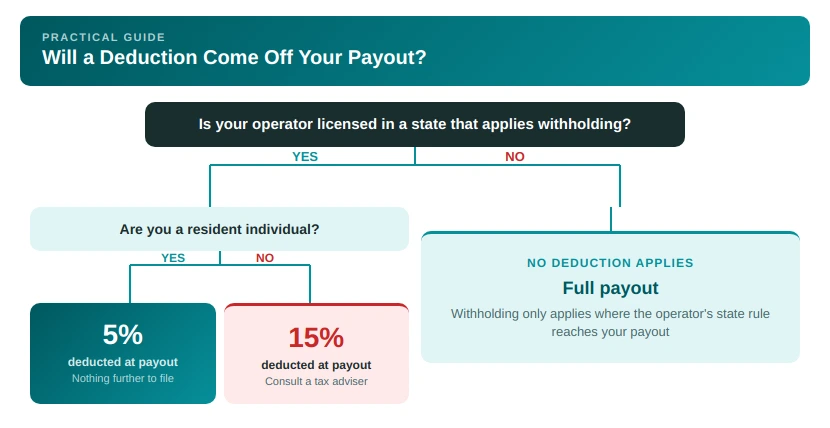
Yes, but in two separate ways. The operator is taxed on its business, and since the start of 2025, a withholding deduction can come off player winnings at payout. Betting is taxed, but whether the deduction reaches you depends on where and with whom you bet. Where it does apply, it is taken automatically.
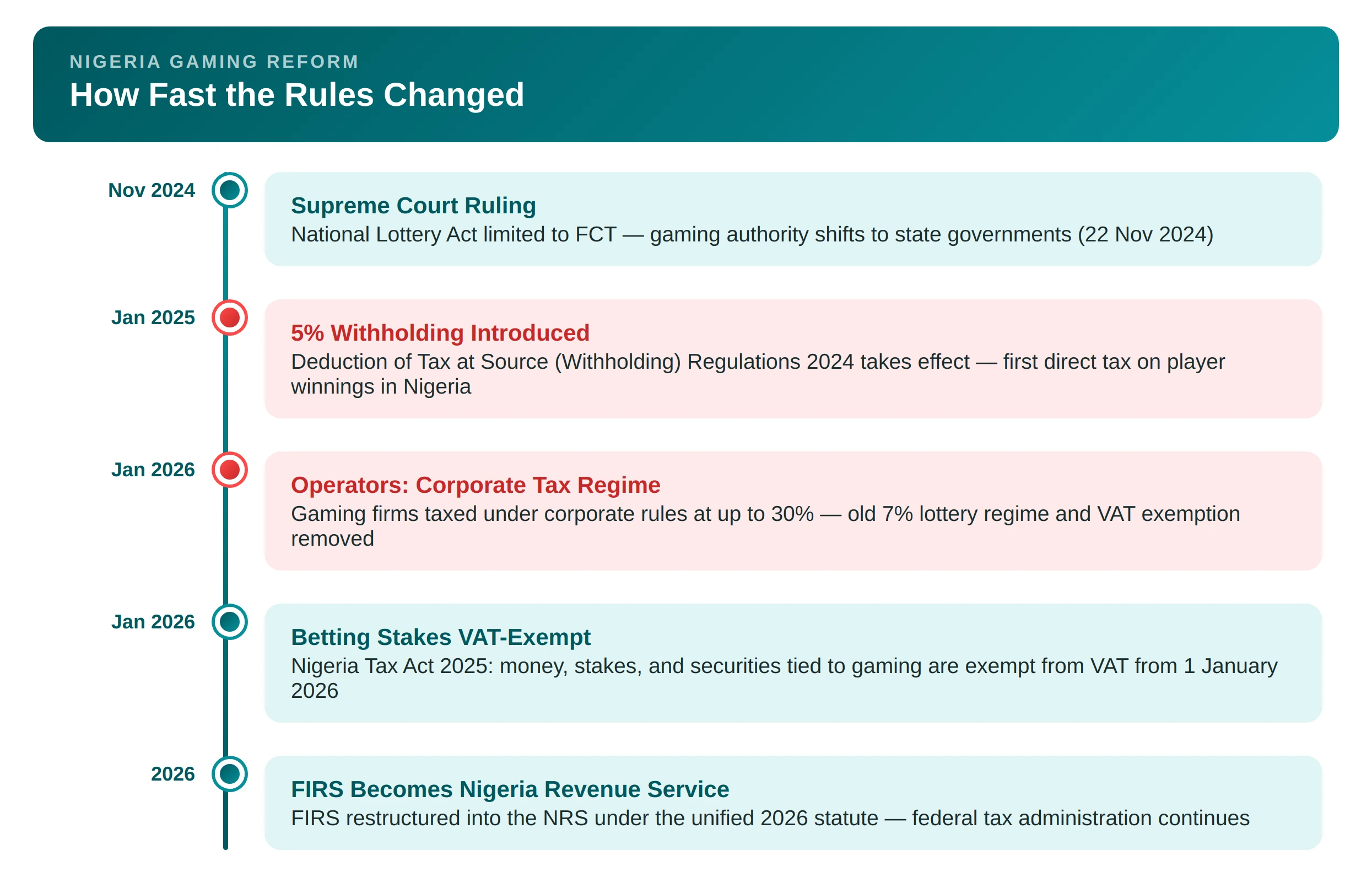
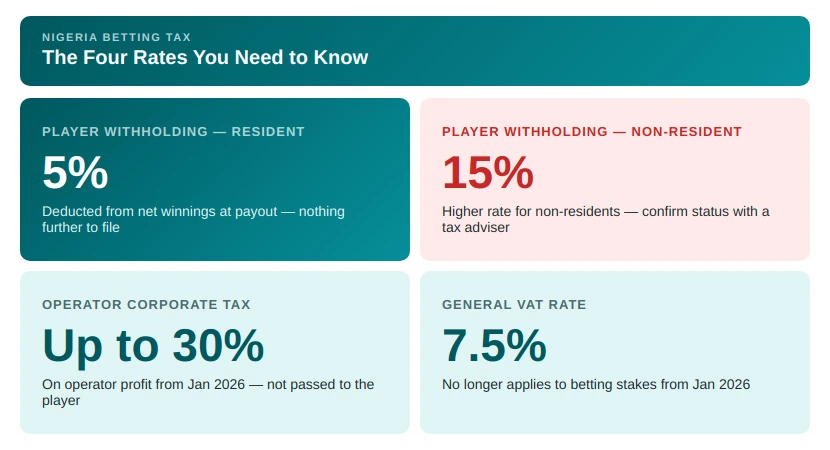
The headline figure most people want is the rate of betting tax on a win, which is 5%: the first time a tax on bet winnings in Nigeria was charged directly, introduced by the Deduction of Tax at Source (Withholding) Regulations 2024 and effective 1 January 2025.
How Betting Taxes Work in Nigeria
Three layers sit on this sector: federal tax law, state gaming law and consumption tax. They do not always line up, which is the root of most confusion.
Federal vs State Tax Responsibilities
On 22 November 2024, the Supreme Court ruled that the National Lottery Act applies only within the Federal Capital Territory, a judgment meaning that the National Assembly has no power to regulate gaming inside the states. That authority now sits with state governments, so within each state's jurisdiction, an operator holding only a federal licence needs a state one as well.
Roughly 45% of states — Lagos and Ogun among them — plus the FCT, have already defined gaming policy, while others are still finalising theirs. Tax on betting now answers to two masters at once: federal rules on the money, state rules on the licence.
Role of the Nigeria Revenue Service (NRS)
The federal collector you may know as the FIRS has been restructured into the Nigeria Revenue Service. It still administers federal taxes under the unified 2026 statute, including the withholding on winnings. For players, the restructuring changes nothing: your operator remits to the relevant body, and the NRS is simply the agency now behind the federal side of sports betting tax.
VAT and Betting Stakes Explained
For years, operators were unsure whether a wager carried Value Added Tax. The Nigeria Tax Act 2025 settled it: from 1 January 2026, money, stakes, and securities tied to gaming are exempt from VAT, so the bet you place is not a VAT-taxable transaction. The general VAT rate, where it applies, stays at 7.5%.
Removing the operator VAT exemption does not make betting tax-free overall; it simply means the consumption-tax layer no longer applies to your stake.
Do Players Pay Tax on Winnings?
So, will you personally hand anything over on a win? Sometimes, and only as an automatic deduction.
Personal Winnings vs Operator Taxes
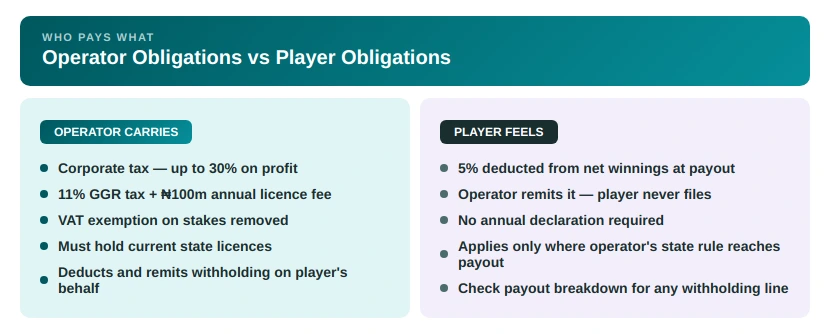
The two streams are easy to confuse. Operator tax is the company’s burden, and from January 2026, it grew sharply: gaming firms are taxed like ordinary companies under corporate rules at up to 30% on profit, losing the old 7% lottery regime and their VAT exemption. None of those charges is passed to the player.
Your side is the withholding, where 5% comes off net winnings at payout, and the operator sends it on. That is also the honest answer when people ask, “Do you pay tax on football bets?”The money may be deducted, but you never remit it yourself.
When Winnings May Become Taxable Income
For a recreational bettor, an occasional win is not income you separately declare, and there is no annual declaration to file. The withholding, when charged, is the mechanism. The line only moves if betting becomes a trade run at scale as a primary income. At that point, it can face a normal income assessment and a real tax liability. If that applies to your situation, get advice from a qualified tax adviser.
State Gaming Boards and Their Role
Since regulatory power shifted downward, state boards are now increasingly the centre of gravity, deciding who operates and what comes off your winnings.
Licensing and Compliance Requirements
With federal reach confined to the FCT, an operator serving a given state needs that state’s licence. Bodies like the Lagos State Lotteries and Gaming Authority set the terms, covering conduct, payouts, anti-money-laundering checks and reporting. Compliance with these requirements is mandatory for any operator serving Nigerian players.
The old National Lottery Regulatory Commission has been dissolved, and operating on an NLRC licence is now treated as illegal, so a credible operator must show current state licensing documents, not a lapsed federal one.
Differences Between State Regulations
Because each state writes its own rules, sports betting tax rates are not uniform. On winnings, the Lagos regulator applies a 5% withholding on net winnings from Lagos-licensed platforms, deducted at payout and remitted to the state treasury.
Separately, state regulators have collectively set an 11% tax on gross gaming revenue plus a ₦100m annual licence fee, both of which fall on operators, not players. Same bet, different treatment, depending on where the licence sits.
Enforcement and Penalties
State boards hold enforcement powers and exercise them by running audits of operators and pulling licences for non-compliance.
For players, the real risk is not a penalty on a normal bet; it is the fallout from using an operator that is not properly licensed in your state, where payouts and protection get shaky. Sticking to a licensed operator is the simplest safeguard.
How 22Bet Fits Into Nigeria’s Tax System
With the framework set, here is where an operator like 22Bet sits inside it.
Operator Obligations vs Player Obligations
22Bet’s duties are operator-side: holding the right state licences, meeting conduct and reporting rules and, where a withholding applies, deducting and remitting it. That last point is the only one you feel. It mirrors the UK model, where the operator carries the full tax burden, and players keep their winnings in full; Nigeria has added a player-side deduction on top in the states that apply it. Your own obligations stay light, with nothing to file for a standard win.
Reporting and Transparency Rules
The reform drive, which helped Nigeria exit the FATF money-laundering grey list, has been geared toward collecting at source and tightening records. A useful habit for you is checking your payout breakdown: if a withholding line appears, that is the deduction being applied. Keeping your own ledger of deposits and withdrawals is sensible, not a filing duty.
Common Misconceptions About Betting Taxes
This section doubles as a quick sports betting tax guide to what is real.
“All Winnings Are Taxed” Myth
False as a blanket claim. A withholding applies only in specific cases, on net winnings, where a federal or state rule reaches your payout.
Do I pay tax on betting winnings? Only as an automatic deduction, never a flat charge on every Naira.
“No Regulation Exists” Myth
Is betting tax-free? No. Regulation didn't disappear; it just shifted. States run licensing, the feds watch the money through the NRS, and it's a $3.6bn-a-year market.
Confusion Between Fees and Taxes
A payment charge or currency-conversion margin is a cost of moving money, not a tax handed down by decree. The withholding on winnings is a genuine tax; a card or wallet fee is not. Your payout breakdown tells you which is which.